Imagine a security officer at a luxury estate noticing an unfamiliar vehicle near a service entrance. A working radio helps, but the team also needs agreed location names, a clear reporting procedure and someone responsible for acknowledging the update.
That is the difference between supplying devices and designing a dependable communication system: the people, equipment and response procedures must work together.
This guide explains how to plan everyday and urgent communications for private estates, luxury properties, close protection teams and other large or security-sensitive sites.
In this guide
- Start with the security operation
- Plan coverage and select the right network
- Organise talkgroups and clear radio messages
- Protect sensitive conversations
- Connect lone worker alerts to a response
- Give the control room a coordinated view
- Turn perimeter awareness into useful information
- Adapt communications for luxury estates and close protection
- Build resilience into daily operation
- Commission, train and measure performance
- Questions to ask a communications supplier
- Frequently asked questions
Start with the security operation, not the handset
Before choosing equipment, establish who needs each update, who acknowledges emergencies and which information can be shared with estate management, reception or external responders.
Create a short operational brief that records:
- People and roles: permanent officers, supervisors, temporary staff, control-room operators and visiting protection teams.
- Working areas: entrances, grounds, residences, service buildings, car parks, basements and off-site movements.
- Busy periods: shift changes, guest arrivals, functions, deliveries and overnight staffing arrangements.
- Response ownership: who receives, acknowledges, escalates and closes each type of report.
- Consequences of lost contact: which tasks cannot continue safely if communications are unavailable.
Separate essential requirements from useful additions. Reliable voice at an isolated gate may matter more than sending photographs; coordinating several buildings may also require location information.
Define acceptance criteria before procurement. An officer should be able to call control from every agreed operational area using their normal radio and earpiece. An emergency activation should reach the designated receiver and start the agreed response procedure. These are practical tests for the proposed design.
Plan coverage and select the right network
Coverage means being able to communicate where the job takes place, not simply having a signal near the office. Walk the working routes and identify where voice, alerts and any required data must function. Thick walls, changes in ground level and below-ground rooms can make apparently nearby locations difficult to connect.
Test both directions: hearing control does not prove that a handheld can transmit a clear reply. Record the device, accessory, location and conditions. Include moving users and representative busy periods, not just stationary tests on a quiet site.
Match the architecture to the footprint
| Approach | Where it may fit | What to verify |
|---|---|---|
| Direct radio-to-radio | A contained site with modest coverage and traffic needs | Every required route, building and simultaneous-call requirement |
| Radio with repeaters or indoor antennas | Estates, multiple buildings or difficult indoor areas | Engineered coverage, power resilience and usable network capacity |
| Push-to-talk over cellular (PoC) | Mobile teams, remote supervisors and widely separated locations | Mobile or Wi-Fi availability, subscriptions, service dependency and outage behaviour |
| A connected or hybrid system | Operations needing both local and wider-area communication | Which features cross the connection, security boundaries and fallback operation |
These approaches can complement one another. Local radio may provide voice without public mobile coverage, while PoC can connect a travelling supervisor. Check the dependencies of each: a linked radio network may still rely on power or IP connections, and PoC requires its supporting network and service.
Comms-Spec’s two-way radio solutions for security teams cover devices, coverage infrastructure and configuration. The right brief should address the complete operational requirement, including accessories and support, rather than a headline range figure alone.
Resolve licensing early
In the UK, licensing depends on the equipment, frequencies and deployment. Compliant PMR446 handhelds offer a licence-exempt option on shared channels, without protection from interference. The exemption does not cover repeater installations. Other business radio arrangements require an appropriate Ofcom licence; licensing does not encrypt conversations.
Confirm the licensing route before purchasing, especially for repeaters, multiple locations or visiting teams. For international work, check national requirements rather than assuming UK authorisation transfers overseas. See Ofcom’s business radio guidance.
Organise talkgroups and clear radio messages
A talkgroup is a configured group of users who can share a conversation on a compatible system. It helps direct information to people who need it. For a luxury property, security, guest services and maintenance may need separate routine communications, with a defined route for contacting control. Separate groups neither create extra capacity nor encrypt conversations. Allow for the expected simultaneous calls and give supervisors a clear way to receive relevant information without every officer monitoring every department.
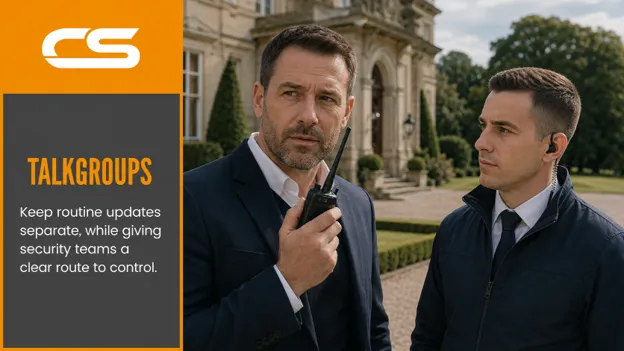
Keep the structure simple: a few clearly named groups for a small operation, with incident groups, supervisor access and supported priority features where needed. Confirm how these work on all devices, including hired radios.
Agree a concise reporting format
A useful routine message identifies the caller, location, observation and requested action. For example:
“Control, this is Gate Two. A delivery vehicle is waiting at the service entrance. Please confirm authorisation.”
This gives control something to verify without assuming unfamiliar activity is a threat. Use agreed site names, not “over there” or “near the back”. Request an acknowledgement or read-back for important instructions.
Train staff to pause, listen and transmit brief messages. Discuss microphone position, background noise, earpiece volume and what to do when a call is not acknowledged. A written procedure should also explain how urgent traffic takes precedence and who contacts the emergency services when needed.
Protect sensitive conversations
Security teams may discuss visitor movements, incidents and personal information. Their communications should be designed around confidentiality as well as clarity. An earpiece reduces audible disturbance around the user; it does not, by itself, secure the radio transmission.
Digital radio does not automatically mean encrypted radio. Encryption must be supported, enabled and compatible across the communication path, with matching authorised keys where required. Basic privacy and stronger encryption options are not interchangeable: confirm the protection supplied for the selected equipment and region. See the Motorola Solutions MOTOTRBO feature guide.
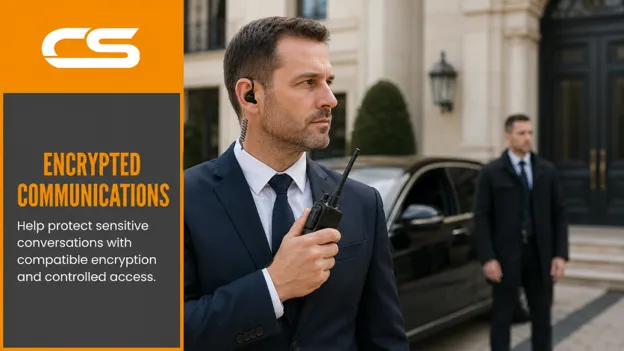
Ask the supplier to explain what is protected: voice, messages, location data, network connections and stored recordings may have different arrangements. If a dispatcher or gateway connects several systems, establish where encrypted information is decrypted and how access is controlled at that point.
Keep a device register, restrict administrative access and define the response to a lost radio or departing temporary user. Assign responsibility for encryption keys and approved configuration changes. Keep sensitive deployment details and protective procedures out of public-facing material.
Share only what the task requires. Encryption cannot prevent exposure through an unattended device, an overheard speaker or an improperly accessed recording.
Connect lone worker alerts to a monitored response
An officer working alone in estate grounds or an isolated service building needs more than a way to speak. There must also be a reliable arrangement for recognising a missed check-in or request for help and acting on it.
The HSE’s lone worker guidance says employers must monitor lone workers and keep in touch, with risk-based training, supervision and regular tests of communication systems and emergency procedures. A device supports those arrangements; it does not replace them.
Understand the different alert types
- Emergency or panic activation: a deliberate action by the user to request assistance.
- Lone worker check-in: a configured activity timer, prompt or agreed contact interval, with escalation if the expected response is missed.
- Man-down or motion-based alert: a supported sensor function that can raise an alert when configured movement or orientation conditions are met.
- Location information: a possible aid to finding the user, subject to coverage, accuracy and system capability.
Capabilities vary by device and software. Test the selected functions with the people who will use them, including how the device is worn and how accidental activations are cancelled. Motorola’s example lone worker and man-down application illustrates this dependence on supported hardware and software; it is not a specification for every radio.
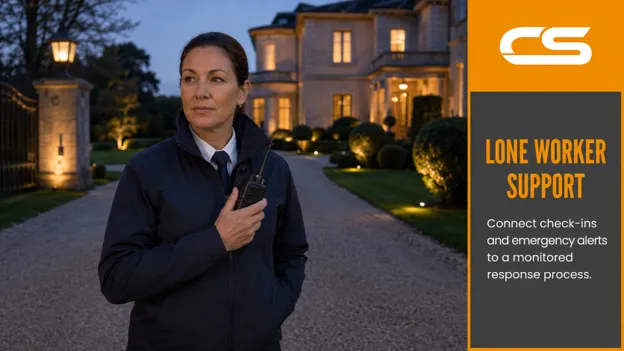
Document who monitors each alert, what information they receive, how they acknowledge it and what happens if they do not respond. Include cover for breaks, shift changes and loss of communications. If a risk assessment says a task needs more than one person, issuing an alarm is not a reason to remove that requirement.
Comms-Spec’s staff panic alarm systems provide a relevant starting point for discussing alerting requirements alongside wider communications planning.
Give the control room a coordinated view
A control-room operator needs to understand what is happening, who is available and which actions remain outstanding, without piecing together unrelated screens and informal conversations.
A security dispatcher can bring supported voice, alarm and location functions into a coordinated workflow. Depending on the platform and integrations, that workflow may also include video, messages and event records. The objective is a usable decision-making environment, not simply a larger number of screens.
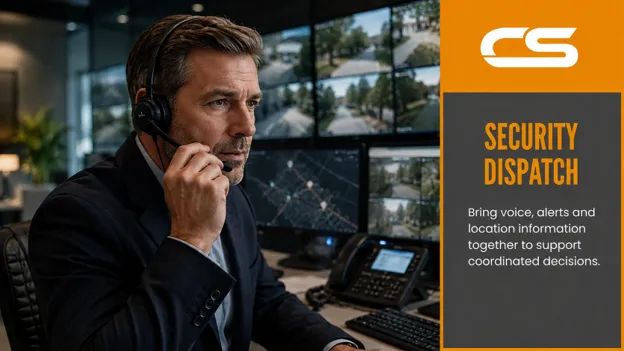
Prioritise the event’s source, time, location, acknowledgement status and responsible operator. Make outstanding actions apparent.
GPS may not reliably identify a room or floor indoors. Indoor positioning can require additional infrastructure: demonstrate its accuracy on site and distinguish current positions from last-known locations. A map symbol should not imply certainty the system cannot provide.
Set access permissions, recording arrangements and retention rules with the organisation’s responsible teams. Operators need training in interpreting information as well as using software. Consider how they will continue working if an individual feed, workstation or connection becomes unavailable.
Turn perimeter awareness into useful information
A perimeter alert tells the team that something may need attention. It does not automatically explain the cause or determine the right response. Useful coordination connects detection with assessment, communication and accountable action.
For example, a service-gate alert could show control the location and available camera view. The operator checks the information, contacts the appropriate officer and records the outcome under the site’s approved procedures. This is an illustrative workflow, not a documented deployment.
Comms-Spec’s integrated security systems bring together areas such as perimeter detection, surveillance, access control and command functions. When considering integration, work through specific events with the supplier. Ask what triggers the alert, which information is transferred, who can act and how a failed connection is identified.
Agree alarm priorities and verification steps. Investigate recurring nuisance alerts so staff do not become accustomed to dismissing notifications.
Any automated response affecting doors, access or people’s movement needs specialist assessment alongside emergency escape and life-safety requirements. Communications technology can support security procedures, but it does not establish legal compliance by itself.
Adapt communications for luxury estates and close protection
The fundamentals remain consistent, but discretion and changing responsibilities make these environments distinctive.
Luxury estates and high-end properties
A luxury estate may combine guest-facing areas, residences, extensive grounds and operational buildings. Staff need to coordinate without broadcasting private information into public spaces or disturbing guests with unnecessary audio.
Test accessory comfort through a full shift with normal work clothing. Discreet equipment must still leave push-to-talk and emergency controls easy to reach and operate.
Define how security communicates with concierge, housekeeping, maintenance and estate management. These teams may need to request assistance without hearing the full security conversation. Comms-Spec’s communications and security solutions for hotels and luxury properties address this wider property context.
Close protection and visiting teams
A visiting protection team may arrive with its own equipment, settings and procedures. Do not assume that radios will interoperate because they look similar or share a manufacturer. Check compatibility, authorised access, licensing and any permitted connection to the property’s system in advance.
Agree a communications handover between the visiting team and the site supervisor. Establish a contact route, responsibility for monitoring it and a fallback if the connection fails. Share only the operational information each party needs, with sensitive protective details kept in the appropriate restricted plan.
Comms-Spec’s close protection communication solutions are relevant where discreet coordination needs to extend across fixed properties, mobile teams and temporary command points.
Build resilience into daily operation
Resilience is the ability to continue essential communication when part of the arrangement is unavailable. It starts with ordinary operating discipline: charged batteries, functioning accessories, correctly configured spare radios and a clear fault-reporting route.
Plan batteries around actual shifts and feature use, not maximum quoted runtime. Assign charging and condition checks, and arrange replacements without leaving a critical role uncontactable.
Review shared points of failure. Two applications using the same handset, mobile network or internet connection may not provide independent backup. Similarly, several radio components may depend on one power supply or network switch. Ask the supplier to make those dependencies visible and explain the practical fallback arrangements.
Keep a short start-of-shift check covering device assignment, battery condition, audio, the correct group and contact with control. Exercise emergency functions only through an agreed test process so routine checks do not create confusion with real alerts.
If performance deteriorates, record where it happens, which users are affected and whether it concerns voice, data or alerts. Comms-Spec’s technical assistance and radio support includes remote and on-site diagnosis, repairs, commissioning and training support. A useful support agreement should make reporting, ownership and escalation clear.
Commission, train and measure performance
Handover should demonstrate that the complete system works and the team knows how to use it.
Test the complete journey
Run agreed exercises from the point where information originates to the point where an action is acknowledged and recorded. Include routine calls, urgent messages, emergency activations, busy periods and the fallback arrangements. Test temporary equipment and visiting users where they form part of the planned operation.
Record passing results, limitations and outstanding actions, with an owner for each issue. Involve users: they can identify awkward accessories or unclear controls that a desk-based check misses.
Train for the actual roles
Officers need practice using their own devices and reporting procedures. Supervisors need to understand priorities, handovers and escalation. Dispatchers need to interpret alerts, manage acknowledgement and recognise missing or unreliable information.
Provide concise instructions and repeat training when equipment, staffing or procedures change. Include temporary staff rather than relying on an experienced colleague to explain the essentials during a busy shift.
Measure useful outcomes
Set a baseline during exercises and review it after changes. Useful measures include the time to acknowledge an alert, messages requiring repetition, unresolved coverage issues and recurring equipment faults. For location-enabled workflows, record whether the position information was sufficiently accurate for the decision being made.
Assess speed alongside understanding and an appropriate response. Only claim measured improvements supported by a consistent method and evidence.
Questions to ask a communications supplier
Before committing to a system, ask:
- Can you demonstrate voice and emergency alert performance across our agreed working areas?
- How will the system handle our busiest period, including simultaneous conversations?
- Which safety and encryption functions are included, optional or dependent on other components?
- Who will receive and acknowledge alerts, and how is a missed acknowledgement handled?
- Which existing systems can connect, and what functionality is lost across any gateway?
- What continues working during a power, network or platform outage?
- What training, maintenance, subscriptions, licences and ongoing support are required?
- What evidence will show that the finished system meets our acceptance criteria?
These questions make proposals easier to compare. The strongest option is the one that fits the operating requirement and can be maintained, not necessarily the one with the longest feature list.
Design communications around the people protecting your site
Dependable security communications align coverage, equipment and procedures with the team’s work. Start with a clear message, the right recipient and an accountable response; add features where they improve those essentials.
If you are reviewing communications for a luxury estate, protection team or complex site, speak to Comms-Spec about your security communication requirements. Bring your site footprint, staffing pattern, existing equipment and priority concerns so the discussion can focus on a practical, supportable design.
Frequently asked questions
Suitable devices, tested coverage, clear group structure, audio accessories and reporting procedures, backed by training and support. Add alerting, location and dispatch capabilities where the operational requirement and risk assessment justify them.
No. Encryption must be supported, enabled and compatible across the system. Confirm the protection and key-management arrangements; a digital label alone does not establish confidentiality.
No. They support risk-based supervision, training and staffing. Every alert needs a defined response, including a fallback when the first receiver is unavailable.
Use a site assessment to identify whether repeaters, indoor distribution or a wider-area service are needed. Test real working locations and the complete design rather than relying on advertised range.
Yes, through supported platforms and integrations. Check compatibility and define what information reaches the operator, who acts and how the response is recorded.
A phone may suit some roles where approved applications and reliable coverage are available. Assess group calling, emergency activation, discreet operation and outage arrangements against the task before deciding.