
Radio hire built for real operations
Whether you’re coordinating an event or running a security operation, our hire service is designed to keep comms reliable, clear, and easy to manage from day one.
All-inclusive hire
Radios, chargers, audio, and scalable coverage options in one package.
Discreet comms
Earpieces and audio options for calm, professional front-of-house operations.
Secure conversations
Encryption-ready radios (AES256 compatible) for sensitive comms.
Coverage you can scale
Base stations and repeaters to reduce dead spots on larger sites.
Licence support included
Guidance or management to keep you compliant and ready to operate.
Supported end-to-end
Dedicated engineering support and always-on availability when needed.
What’s included with Radio Hire
Click an item to see what it covers, the challenge it solves, and the outcome it delivers.
Two-way radios
Professional radios for clear, instant coordination
When timing matters, teams need comms that don’t depend on mobile signal. We supply professional handheld radios prepared for deployment—ideal for event operations, venue teams, and security coordination.
Batteries, chargers & essentials
Power and practicality for long shifts
A hire setup is planned around real shift patterns—keeping radios in rotation with chargers, batteries and essentials so teams stay connected throughout the day (and night) without avoidable downtime.
Discreet earpieces & audio accessories
Quiet coordination in public-facing environments
Discreet audio keeps instructions private and professional—especially for door teams, patrols, and front-of-house staff. It reduces “broadcasting” your response plan and improves clarity in noisy environments.
Base stations & control-point setup
Stronger coordination from a central control point
For larger operations, base stations support an ops desk or control room with stable comms—ideal for coordinating teams across zones, handling escalations, and maintaining oversight.
Repeaters & coverage extension
Reduce dead spots across large or complex sites
Multi-floor venues, basements, steel structures, and wide footprints can create patchy coverage. Repeaters and coverage extensions help improve reliability across priority zones so critical calls don’t drop.
Encryption-ready comms (AES256 compatible)
Protect sensitive comms from eavesdropping
Security and operational comms can be sensitive—incident details, access decisions, VIP movements. Encryption-ready radios (AES256 compatible) help keep conversations confidential and controlled.
Channel plan & programming
Channels organised by team, role, and escalation
Unstructured radio traffic creates confusion. We can programme a clear channel plan (e.g., Ops / Security / Production / Supervisors / Control) so the right people hear the right messages with less chatter.
Licensing guidance / management
The right licence approach—handled simply
Licensing can be the blocker that slows everything down. Hire can include licence management, and for security operations, we can guide you on options like Simple UK vs Site Specific, depending on privacy and interference risk.
Dedicated engineering + hire fleet support
Support that keeps you operational
When requirements change or an issue appears mid-operation, you need a provider who can respond quickly. Our hire service includes engineering support and operational help to keep comms running smoothly.
Choose your hire setup
How It Works
Tell us your operation
We design the comms setup
Configure & prepare
Deliver & deploy
Support during operations
Hire capability built for high-pressure environments
Radio hire works best when it’s planned around real workflows—coverage, clarity, privacy, and support—so teams stay coordinated when the environment gets busy.
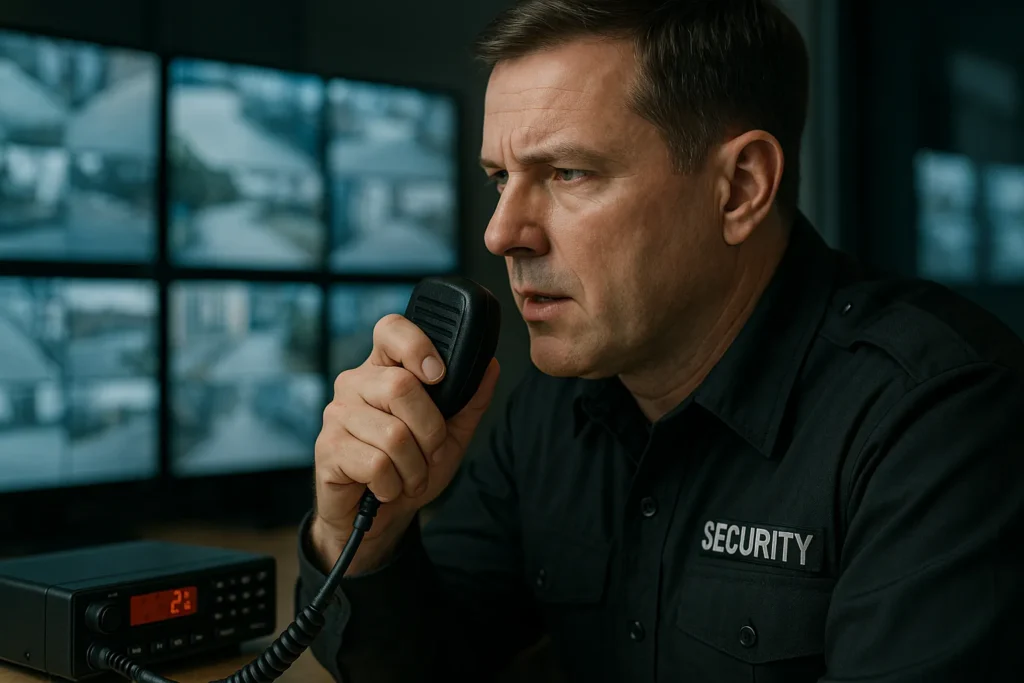
Discreet comms for public-facing security
Discreet comms for public-facing security (earpieces & audio options)
Challenge: In security and front-of-house roles, audible instructions can escalate situations, undermine professionalism, or reveal intent to the public. Noise and crowd ambience also reduce clarity.
Capability: We provide discreet earpieces and role-appropriate audio accessories so officers and supervisors can communicate quietly and clearly—without “broadcasting” the plan.
Benefits: Calmer interactions, more professional presence, improved message clarity in noisy environments, and smoother coordination between posts.
Secure communications for sensitive operations
Secure communications for sensitive operations (encryption-ready, AES256 compatible)
Challenge: Some comms can’t be overheard—incident details, VIP movements, access decisions, and response coordination are operationally sensitive. Unprotected comms increases risk and can compromise outcomes.
Capability: Encryption-ready radio options (including AES256-compatible radios) help keep conversations confidential and controlled, particularly in security-led deployments.
Benefits: Reduced eavesdropping risk, stronger operational integrity, and more confidence sharing sensitive information over the network.
Emergency escalation and incident response
Emergency escalation and incident response (urgent alerts, clear workflows)
Challenge: When something escalates, teams don’t have time for long explanations. If urgent calls get buried in general traffic, response slows and risk increases.
Capability: Radios can include emergency alert capability, and we can structure channel plans to support escalation—helping priority communications reach supervisors/control quickly.
Benefits: Faster response, clearer incident handling, less confusion during peak periods, and better control when pressure is high.
Coverage planning for large or complex environments
Coverage planning for large or complex environments (repeaters & control points)
Challenge: Large sites, multi-floor venues, basements, steel structures, and wide footprints create dead spots and unreliable coverage—exactly where you need comms to work.
Capability: We can recommend a practical coverage approach and include repeaters and/or base station/control-point setups where needed to improve reliability across key zones.
Benefits: Fewer dropped calls, less “radio chasing,” better coordination between teams in different zones, and more dependable comms throughout the operation.
Operationally organised comms
Operationally organised comms (channel plan, programming, and distribution-ready kits)
Challenge: Even with good radios, messy channel structures and poor preparation cause confusion: cross-talk, missed updates, and teams on the wrong channels—especially when staff rotate.
Capability: We programme radios with a clear channel plan aligned to roles (Ops, Security, Production, Supervisors, Control), and prepare kits so they’re easy to distribute and adopt quickly.
Benefits: Cleaner radio traffic, quicker onboarding, fewer user errors, and smoother coordination across departments.
All-in-one hire packages
All-in-one hire packages (radios, accessories, coverage options, licensing support)
Challenge: Piecing together radios, chargers, audio, coverage equipment, and licensing slows deployment and creates gaps—especially when deadlines are tight.
Capability: Hire packages can be supplied as a complete operational setup: radios, accessories, and scalable coverage options, with licensing guidance/management available depending on requirements.
Benefits: Faster mobilisation, less admin, fewer last-minute surprises, and a clearer “one supplier, one solution” experience.
Short-term or long-term flexibility
Short-term or long-term flexibility (scale up/down as needs change)
Challenge: Requirements rarely stay static—events change size, venues change layouts, security operations scale up, or additional teams are added at short notice.
Capability: Hire is designed to scale in quantity and duration, with setups that can be adjusted as the operation evolves.
Benefits: Right-sized comms without long-term commitment, and the ability to adapt without starting over.
24/7 support, 365 days
24/7 support, 365 days (when you can’t pause the operation)
Challenge: Live operations don’t run on office hours. When comms issues happen mid-shift, downtime creates risk, cost, and disruption.
Capability: Support is available around the clock to help triage and resolve issues quickly—whether that’s guidance, adjustments, or the right next step to restore stable comms.
Benefits: Faster stabilisation, reduced operational gaps, and confidence that help is available when timing matters most.
How we support each market
From high-footfall venues to wide outdoor sites, radio hire keeps teams aligned with instant comms that doesn’t depend on mobile coverage.
Frequently Asked Questions
- What’s included in a two-way radio hire package?
Most professional radio hire packages include the essentials needed to operate immediately on-site:
Handheld radios (pre-checked and ready to use)
Batteries and chargers sized to your shift pattern
Basic audio accessories (where required)
A programmed channel plan so teams are organised from day one
For larger or more complex sites, packages can also include coverage and control options such as base stations and repeaters, plus licensing guidance/management depending on the deployment.
- What’s the difference between “walkie talkie hire” and professional two-way radio hire?
“Walkie talkie hire” often implies simple, licence-free radios with limited control and variable performance. Professional two-way radio hire is typically built for real operations: clearer audio, better reliability, role-based channels, and options for discreet earpieces, escalation workflows, and coverage extension (repeaters/base stations) when a site is large or complex.
If comms is safety- or time-critical, professional hire is usually the better fit.
- How many radios are needed for an event or venue?
It depends on roles and how you want comms structured. A practical starting point is to allocate radios by function:
Operations / duty manager
Security / supervisors
Production / stewards
Traffic / logistics / car parks
Technical / facilities / maintenance
What matters most is avoiding “everyone on one channel.” A structured channel plan is often more valuable than simply adding more radios.
- Do hired radios work without mobile signal?
Yes, traditional two-way radios communicate independently of mobile networks. That’s one of the main reasons events and security teams use them: instant push-to-talk communication that doesn’t rely on 4G/5G coverage or congested public networks.
- How can radio coverage be improved on large sites or buildings with dead spots?
Dead spots are common in multi-floor venues, basements, steel structures, and wide footprints. Coverage can be improved by adding:
Repeaters to extend range and reduce dropouts
Base stations / control points to strengthen coordination from an ops desk
A well-designed hire setup treats coverage as part of the plan, not an afterthought—especially where missed calls create operational risk.
- Is a licence needed for hired two-way radios in the UK?
Licensing depends on the radio type, frequencies, and the level of control/privacy required. Some deployments use simpler licensing approaches, while others benefit from more controlled, site-specific arrangements to reduce interference risk and improve privacy.
A good hire provider will guide the licensing route early so it doesn’t become the last-minute blocker that delays deployment.