Perimeter security systems protect a site most effectively when physical barriers, detection, CCTV and communications work together. A connected approach helps security teams identify unusual activity, verify what is happening and coordinate an appropriate response before an incident develops.
For site managers, facilities managers and security leads, the priority is not simply choosing more equipment. It is ensuring that each layer supports the next, from the boundary to the control room and the people responsible for acting. This guide explains how to plan that approach across commercial premises, construction sites, industrial facilities and high-value properties.
Table of Contents
What Are Integrated Perimeter Security Systems?
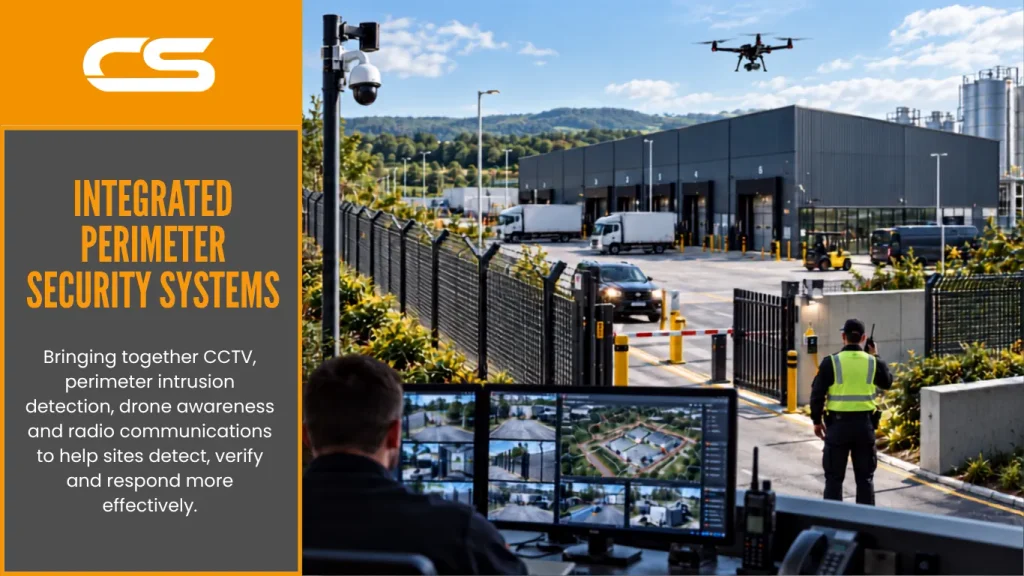
An integrated perimeter security system combines measures that deter or delay unauthorised entry, detect relevant activity, help operators verify alerts and support a coordinated response. The components may include fencing, gates, intrusion sensors, CCTV, access control, monitoring software and radio communications. The design should follow the site’s risk assessment rather than a fixed equipment list.
The key distinction is the connection between layers. A sensor can identify activity at a boundary, but an operator still needs to understand its cause and decide what action is appropriate. Comms-Spec’s integrated security systems bring detection, surveillance, access control and command functions into a coordinated solution.
Designing Perimeter Protection Around Site Risks
Assess the boundary before choosing equipment
Walk the site with the people who operate it. Identify public approaches, vehicle entrances, pedestrian gates, service yards, roof access, vulnerable assets and areas where activity is difficult to observe. Consider how the boundary changes during deliveries, maintenance and out-of-hours operation. A system designed around the wrong layout may create unnecessary alerts while leaving important areas insufficiently covered.
Temporary boundaries and changing layouts
Construction sites and temporary compounds need particular attention. Hoarding, access routes and storage areas can move as work progresses. The security design should allow detection zones, camera views and response procedures to be reviewed as the site changes, rather than assuming the initial installation will remain suitable.
Match protection to the consequence of an incident
A small commercial yard may need a different approach from a large logistics facility or sensitive industrial site. Consider what must be protected, how quickly an incident could develop and whether personnel are available to respond. The aim is to establish proportionate layers and clear operational requirements before selecting individual technologies.
The Layers That Make Up a Perimeter Security System
Physical barriers and controlled access
Fencing, walls, gates and suitable vehicle barriers establish the boundary and can delay entry. Access control manages legitimate movement through designated points. Their effectiveness depends on installation, maintenance and how they interact with deliveries, emergency access and day-to-day operations.
Perimeter intrusion detection systems
Perimeter intrusion detection identifies activity that may indicate an attempted breach and sends an alert for assessment. NPSA guidance distinguishes barrier-mounted, ground-based, freestanding and rapidly deployable systems. Detection does not itself provide a physical delay, so it should be considered alongside the barrier and the response arrangements.
Choosing a detection method
Fence-mounted sensors, buried systems, infrared beams and other technologies suit different environments. The decision should account for terrain, vegetation, weather, nearby activity and the required detection area. No system is free from nuisance alarms, so commissioning must establish appropriate sensitivity and verification procedures.
CCTV, thermal imaging and visual verification
Cameras can support detection, assessment, tracking and recording. Fixed, pan-tilt-zoom and thermal options have different uses, and their suitability depends on lighting, field of view, image quality and the intended task. NPSA’s CCTV guidance explains how surveillance can complement intrusion detection. See Comms-Spec’s CCTV and perimeter security capabilities for the commercial solution.
How the layers complement one another
| LAYER | PRIMARY PURPOSE | INTEGRATION CONSIDERATION |
| Physical barriers / access control | Deter, delay and manage authorised entry | Maintain safe access and clear boundary zones |
| Intrusion detection | Identify activity at a configured boundary | Send a location-specific alert for verification |
| CCTV / thermal imaging | Assess activity and record useful footage | Show the relevant view when an alert occurs |
| Monitoring / communications | Coordinate decisions and the response | Assign ownership, dispatch and record outcomes |
How Integrated Security Systems Turn Alerts Into Action
The greatest operational benefit comes from turning separate signals into a useful sequence. The following is an illustrative workflow, not a claim about a particular installation.
Connect detection to the right camera and operator
A sensor event should identify the affected zone and, where supported, bring the appropriate camera view or site map to the operator. The operator checks the available information, considers legitimate activity and follows the agreed escalation procedure. Recurring nuisance alerts should be investigated rather than routinely dismissed.
Make the alert useful, not just visible
A useful event record identifies the source, location, time, priority and acknowledgement status. Where compatible systems allow, camera presets and incident records can reduce the need to search across separate screens. Integration should be tested end to end before it is relied upon.
Communicate, dispatch and close the incident
Once the situation is assessed, control needs a dependable way to contact the appropriate team, confirm instructions and record the outcome. Radio coverage and the agreed response procedure matter as much as the monitoring interface. For a wider explanation of network planning and control-room coordination, see the security team communications guide. Radio hire for security operations can support temporary deployments where a suitable fleet and coverage arrangement are required.
Where Drone Detection Fits Into Perimeter Security
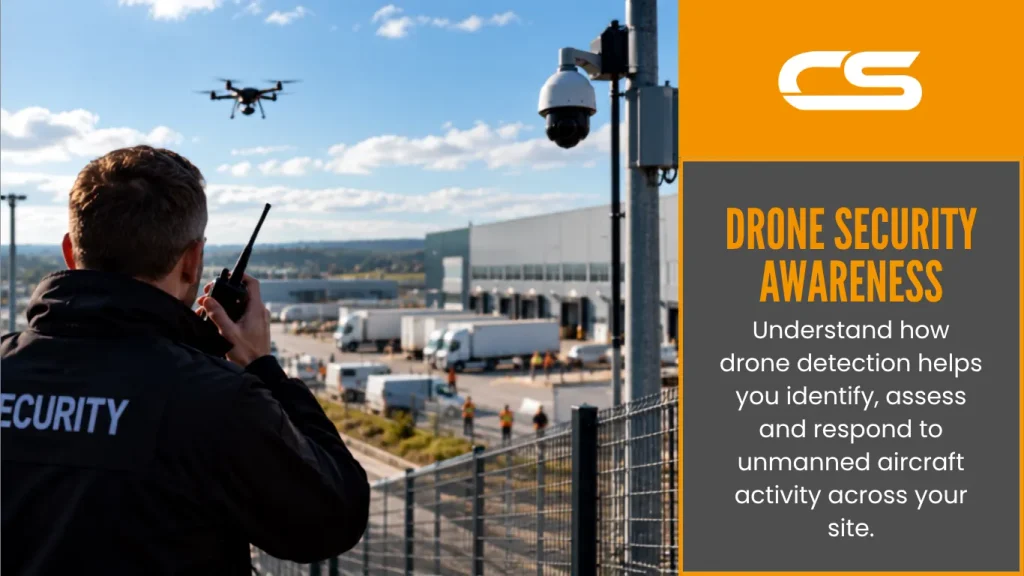
Drone detection may be appropriate where a site has a credible aerial security or privacy risk, such as sensitive industrial premises, large estates or certain critical infrastructure. It is a complementary capability, not a requirement for every perimeter. Ground-based security remains necessary because aerial awareness does not protect gates, fences or buildings against ordinary intrusion.
Distinguish detection from an authorised security drone
Drone detection identifies and tracks relevant aircraft using suitable sensing technologies. An authorised surveillance drone, by contrast, may provide additional views of a large site or help assess an incident. Comms-Spec offers both drone detection systems and UAV security solutions. Each should be considered against its own operational requirement.
Connect aerial alerts to a proportionate response
Where integration is supported, an aerial alert can inform control-room assessment and help operators coordinate ground teams. Detection does not establish hostile intent or authorise interference with an aircraft. The CAA’s airspace guidance explains that ownership of land does not remove airspace rules. The Department for Transport’s counter-drone guidance also highlights the legal and safety implications of active countermeasures. Any such capability requires separate specialist assessment and appropriate authority.
Applying Perimeter Security Systems to Different Sites
Construction sites and temporary compounds
Construction site security systems should account for moving boundaries, changing vehicle routes, plant storage, temporary power and periods when the site is unoccupied. Redeployable detection or CCTV may be appropriate, but monitoring responsibilities and access arrangements must remain clear throughout the project.
Industrial, logistics and remote facilities
Industrial and logistics premises often require coordinated coverage of long boundaries, loading areas and multiple entrances. Remote sites may also need resilient power and connectivity. The design should prioritise the areas where a delayed or missed alert would have the greatest operational consequence.
Large estates and luxury properties
Large properties need effective boundary protection without unnecessarily disrupting residents, guests or normal services. Discreet cameras, controlled access and clear communication between security and property teams can be important. Comms-Spec’s hotel and luxury property security solutions provide a relevant sector-specific starting point.
Choosing and Maintaining the Right Perimeter Security Solution
Questions to ask during a site survey
A useful survey should establish the protected assets, boundary conditions, existing equipment, monitoring arrangements and the actions required when an alarm occurs. Ask which technologies can integrate, what information will reach the operator and how the proposed solution will be tested under realistic operating conditions.
Power, connectivity and system compatibility
Check the dependencies between cameras, sensors, networks and control-room systems. Agree what happens if a connection, power supply or device fails, and how operators will recognise the fault. Existing equipment should be assessed for compatibility rather than assumed to work with a new platform.
Maintenance, privacy and operational testing
Establish responsibility for inspecting barriers, cleaning and testing cameras, checking detection zones and reviewing alarm records. Surveillance must also be designed around an appropriate lawful purpose, access controls and retention arrangements. The ICO’s CCTV guidance provides a practical starting point for these responsibilities. Automated actions affecting doors or people’s movement require separate life-safety assessment.
For teams working alone, the related guide to lone worker protection and encrypted communications explains how personal alerts and secure channels support a monitored response. Perimeter protection and personnel safety should be planned together, while retaining their distinct operational requirements.
Frequently Asked Questions
What are perimeter security systems?
Perimeter security systems combine physical barriers, detection, CCTV, access control and response procedures to protect a site’s boundary. The appropriate layers depend on the risks, layout and people available to monitor and respond.
What is the difference between perimeter detection and CCTV?
Perimeter intrusion detection raises an alert when configured activity is detected at a boundary. CCTV can help an operator assess what caused the alert, track activity and record evidence. Used together, they provide more useful information than either system alone.
How do you choose perimeter protection for a construction site?
Start with the site layout, changing access points, assets, working hours and available response team. Select suitable temporary or permanent barriers, detection and cameras, then confirm power, connectivity, monitoring and how the system will adapt as the project changes.
Can drone detection be integrated with perimeter security?
Yes. Appropriate drone detection can provide aerial alerts to a control room and support visual verification and coordinated response. It complements ground-based security but does not replace it. Any active counter-drone measures require separate legal and operational assessment.
How much does a commercial perimeter security system cost?
Cost depends on perimeter length, existing infrastructure, detection and CCTV requirements, monitoring, integration and maintenance. A site survey is the most reliable way to define the scope and compare a suitable permanent or temporary solution.
Comms-Spec designs, supplies and supports integrated communications and security solutions for demanding environments. To discuss your boundary risks, existing systems and operational requirements, contact Comms-Spec to arrange a site survey or enquiry. The team can help assess an appropriate combination of perimeter detection, CCTV, communications and other security layers.
Sources and further reading
The guidance below supports the technical and regulatory statements in this article. The site scenarios and workflow examples are illustrative, not case studies.