If your team uses two-way radios, there is a fair chance you need a licence from Ofcom, and an equally fair chance nobody in the business has ever checked. It is one of the quieter compliance gaps in UK operations. Radios get bought, handed out, and used for years without anyone asking whether they are legal to transmit on.
This guide clears that up. It covers when a licence is actually required, the main Business Radio licence types and what each one allows, what they cost, and how to stay on the right side of the rules. We have kept it practical and focused on business use, so if you are here about a TV licence, a marine VHF licence for a boat, or an amateur (ham) radio licence, those are separate regimes and outside our scope.
The short answer
For most businesses using professional two-way radios, yes, you need a licence. Under the Wireless Telegraphy Act 2006, using radio equipment without either a licence or a specific exemption is a criminal offence. The main exception is a category of low-power consumer radios called PMR446, which are licence-exempt. More on those below, because they are where a lot of the confusion starts.
So the real question is not usually “do I need a licence” but “which licence, and does my current kit even qualify for the licence-free route.”
Why the licence exists
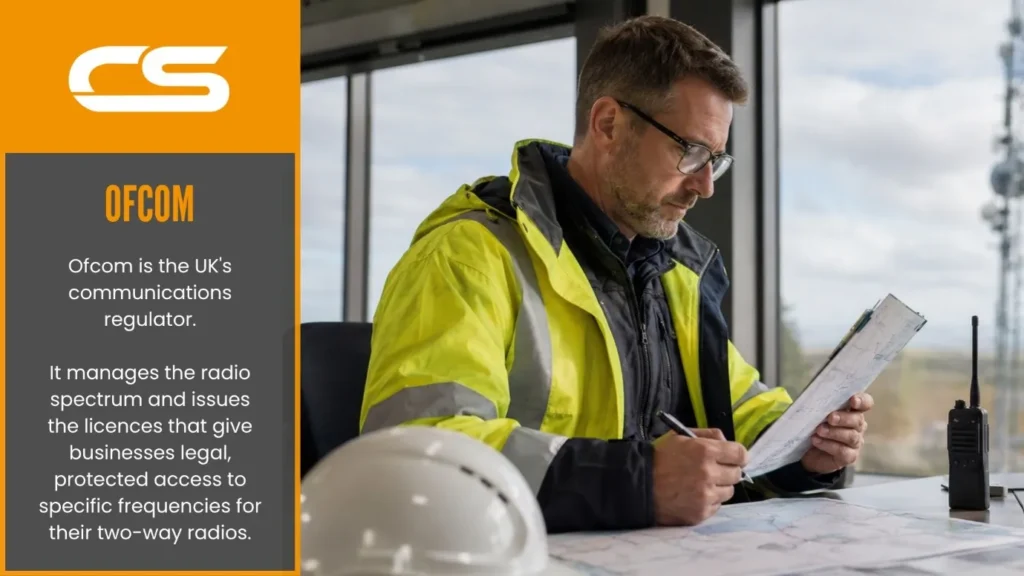
It helps to understand what you are actually paying for. Radio spectrum is a shared, finite resource. Emergency services, aviation, shipping, utilities and thousands of businesses all rely on it, and without coordination their signals would interfere with one another. Ofcom, the UK’s communications regulator, manages that spectrum and issues licences that give you defined frequencies to work on.
A licence is not red tape for its own sake. It gives your team legal, protected access to specific channels, which in practice means cleaner communication with less interference from other users nearby. For anyone running safety-critical operations, that reliability is the whole point.
When you don’t need a licence: PMR446
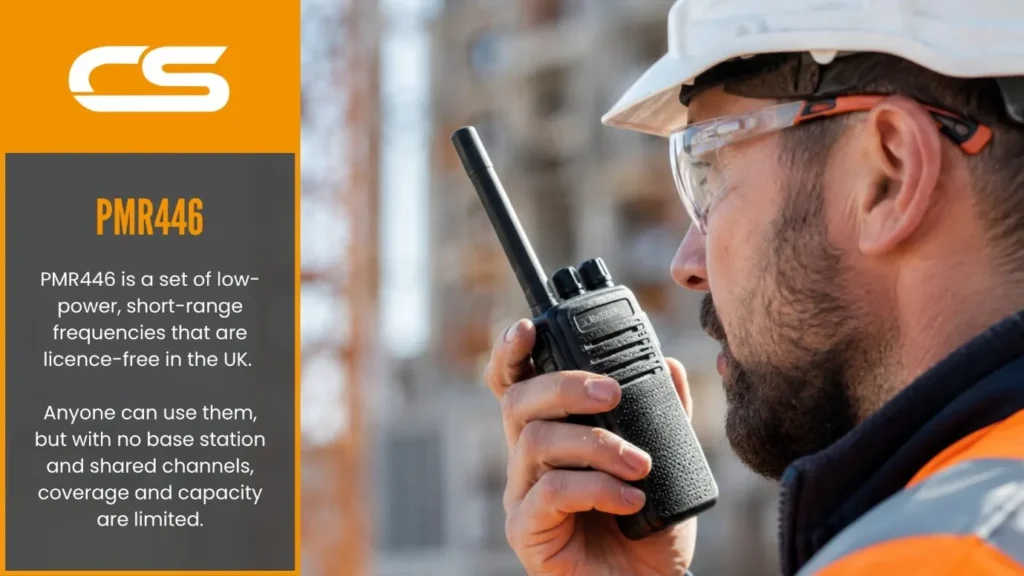
PMR446 radios are the exception that proves the rule. These are short-range, low-power handsets that operate on a set of shared frequencies around 446 MHz, and they are licence-exempt in the UK. Anyone can buy and use them without applying to Ofcom.
They suit genuinely small, simple jobs: a handful of staff in one building, a small shop floor, a family event. But the trade-offs are real. Because the channels are open to anyone within range, you can end up sharing them with a neighbouring business or the public. There is no base station and no way to extend range with fixed infrastructure. Coverage is limited, and on a busy site you may find your channel already occupied by someone you have never met.
For a serious operation, that is usually the moment to move to a licensed system. Which brings us to the Business Radio licences.
The Business Radio licence types
Ofcom has rationalised what was once a sprawling list into five Business Radio licence products, split into two groups. Three are “Light” licences, which are pre-packaged, quick to apply for online, and use shared frequencies you coordinate yourself. Two are “Technical” licences, which Ofcom coordinates for you and which suit more complex or higher-value deployments.
For most businesses, one of the two Simple licences is the right starting point.
Simple UK Light. This authorises hand-portable and mobile radios anywhere in the UK, but does not permit a fixed base station. Licensees share access to 19 frequencies across four Business Radio bands, with a maximum of 5 watts, and self-coordinate with other Simple UK licensees. The fee is £75 for five years. It suits teams that move between sites, such as security contractors, engineers or event crews working in different locations.
Simple Site Light. This authorises a radio system, including a base station and mobiles, operating within a small area of roughly one kilometre or less. You need one licence per site. It is the natural fit for a single fixed location such as a hotel, a warehouse, a factory or a leisure venue. The fee is also £75 for five years.
Suppliers Light. This is aimed at radio suppliers demonstrating or hiring out equipment, rather than end users, so most businesses can set it aside.
Technically Assigned and Area Defined. These are the “Technical” licences. Rather than shared channels, Ofcom assigns frequencies coordinated specifically for your site and equipment, which reduces the risk of interference and supports larger, more demanding networks. They require technical coordination, take longer to process, and carry an annual fee rather than a flat five-year charge, with the cost depending on the technical detail of what you request. These come into their own for large or complex sites, wide-area coverage, or operations where guaranteed channel quality matters.
What it costs
The two Simple licences are refreshingly straightforward: £75 for five years, which works out at £15 a year. That figure is fixed regardless of how many radios you run under the licence, so the per-radio cost falls the more handsets you deploy.
Technical licences are priced differently, on an annual basis, and vary with the frequencies and configuration involved. If you are weighing up a technical licence, the honest answer on cost is that it depends on the design, and it is worth getting the specification right before worrying about the fee.
What happens if you don’t have one
This is the part businesses tend to underestimate. Operating radio equipment without the required licence is a criminal offence under the Wireless Telegraphy Act 2006. Ofcom has enforcement powers that include investigating interference, entering premises, and seizing non-compliant equipment. Penalties on conviction can include a fine and, for the more serious offences, imprisonment.
Beyond the legal exposure, there is an operational risk. Unlicensed use on the wrong frequencies can interfere with other spectrum users, including safety-critical services, and can see your own system shut down at the worst possible moment. For a business that depends on its radios day to day, losing them to an enforcement action is a genuine disruption, not a hypothetical.
How to avoid the compliance gap
Staying compliant is not difficult, but it does need someone to own it. A few practical steps:
Check what you are actually running. If your radios are PMR446, you are exempt. If they are anything more capable, assume a licence is required until confirmed. If you have inherited a radio fleet with no paperwork, treat that as a gap to close, not a reason to assume it was handled.
Match the licence to how you operate. A single fixed site points to Simple Site; teams moving around the country point to Simple UK; a large or interference-sensitive operation points to a technical licence. Getting this right at the start avoids paying for the wrong thing.
Keep the licence current. Light licences run for five years, so diarise the renewal. Technical licences carry an annual fee, so make sure it is being paid.
Get advice if the picture is unclear. Frequency planning, base station coverage and multi-site coordination are exactly the areas where a specialist saves you time and prevents expensive mistakes. This is bread-and-butter work for an experienced two-way radio partner, and it is a lot cheaper than getting it wrong.
Where Comms Spec fits in
We have spent decades designing and running professional radio systems for demanding UK environments, from construction sites and events to hotels, ports and marine operations. On a busy build, for instance, getting the licence right is only one part of a wider picture that also covers coverage, channel planning and battery management, which we set out in our guide to what construction sites need from a reliable communication system. Part of that work is always making sure clients are on the right licence for how they actually operate, and taking the guesswork out of the Ofcom process.
If you are not sure whether your radios are licensed correctly, or you are planning a new system and want it set up properly from day one, our Radio Licensing service can help you get it right. Talk to our team and we will point you to the licence that fits.