Two radios can look identical, cost the same, and come from the same manufacturer, yet one keeps a site connected all shift and the other leaves crews shouting into dead air by mid-afternoon. The difference is rarely the handset. It is coverage and power, the two things that quietly decide whether a communication system actually works when the building is half-built and the pressure is on.
Our guide to what construction sites need from a reliable communication system sets out the five elements that have to work together. This piece goes deeper on the two that cause the most day-to-day frustration: getting a signal into every corner of a growing structure, and keeping radios powered from the first briefing to the last.
Why coverage is so hard on a construction site
A construction site is close to a worst-case environment for radio. The structure that the signal has to travel through is dense, changing daily, and full of the exact materials that block radio waves. Reinforced concrete, structural steel, basement slabs and lift shafts all absorb and reflect signal. A radio that reaches clean across an open plot on day one can struggle to get from the third floor to the gate once the frame goes up.
The problem also moves. Coverage is not a fixed property of the site, it is a property of the site as it is right now. Each pour, each new floor and each block wall changes how signal behaves. Plan coverage for the empty ground and you will be chasing dead spots for the rest of the build.
UHF or VHF: getting the basics right
One of the first decisions, and one that is expensive to get wrong, is the frequency band. Two-way radios generally run on either VHF or UHF, and the two behave very differently in a built environment.
VHF (very high frequency, typically 136 to 174 MHz) uses longer wavelengths that travel further across open, unobstructed ground. That makes it a reasonable choice for wide, flat outdoor sites with little standing structure. The catch is that those longer waves are readily blocked by buildings, concrete and steel.
UHF (ultra high frequency, typically around 400 to 470 MHz for business radio) uses shorter wavelengths. It does not travel as far in open air, but its shorter waves diffract and reflect around building-scale obstacles, doorways, corners and stairwells, far more effectively. As radio manufacturer Motorola Solutions notes, that superior penetration through walls and floors is the single biggest practical reason indoor and multi-storey operations favour UHF. If your team is working inside a structure, through concrete, or across multiple floors, UHF is almost always the right starting point.
This is exactly the kind of decision that a coverage survey answers properly, rather than guessing and hoping.
Extending coverage: repeaters, DAS and leaky feeder
On a compact, low-rise site, well-specified handhelds talking directly to each other, radio to radio, may give you all the coverage you need. On anything larger or vertically complex, that approach runs out of road, and you need infrastructure to carry the signal into the places handhelds cannot reach.
There are three main tools, in rough order of scale:
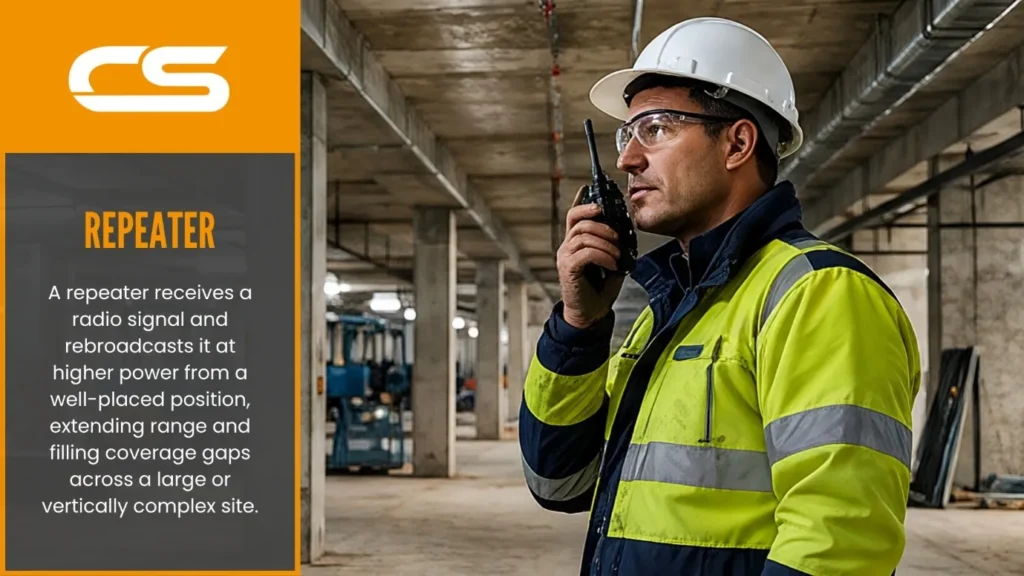
A repeater receives signal and rebroadcasts it at higher power from a well-chosen position, extending range and filling gaps across a wider area. On many sites a single, sensibly placed repeater transforms coverage. It is often the most cost-effective first step when direct radio-to-radio contact starts to fail.
A distributed antenna system (DAS) spreads a network of antennas through the structure, feeding signal into the parts of a large or deep building that a single repeater cannot serve. This is the answer for high-rise cores, large floor plates and complex interiors.
A leaky feeder is a specialised cable that radiates and receives signal along its whole length, effectively a long, thin antenna threaded through the structure. It comes into its own in exactly the places radio hates most: deep basements, tunnels, plant rooms and lift shafts, where nothing else reliably reaches.
The practical test for any of these is blunt and worth repeating on site: can the worker on the top floor reach the gate, can the basement team reach the surface, and does that hold true as the building keeps growing?
The coverage survey: designing for the finished building
The single most useful thing you can do about coverage is survey for it before work begins, and design the system around the finished structure rather than the empty site.
A proper survey looks at the drawings, the materials, the number of floors and the hardest-to-reach corners, then specifies where infrastructure needs to go and what band and power make sense. It anticipates the dead spots, the basement plant room, the lift core, the far end of a long floor plate, before they become a daily problem rather than discovering them once crews are already relying on the system. This is why our two-way radio solutions are surveyed, designed and tested before work begins. On a phased build, the survey also plans for how coverage needs to change as the structure rises. Retro-fitting coverage into a live, occupied site is always slower and more expensive than designing it in from the start.
Why batteries decide reliability more than any spec sheet
Coverage gets a radio’s voice across the site. Power is what keeps it able to. And this is where a lot of otherwise well-specified systems quietly fail.
A radio is only reliable while it has charge. A system that performs well at the morning briefing but fades by mid-afternoon is not reliable, it has simply not failed yet. On a construction site, where shifts are long and a flat radio can mean a worker cannot raise the alarm, that is not an inconvenience, it is a safety gap.
The baseline expectation is straightforward: a construction radio battery should comfortably last a full working shift as standard. But real-world battery life is shaped by things that never appear on a spec sheet. Heavy transmit use drains a battery faster than light use. Cold weather, a British construction reality for a good part of the year, reduces the effective capacity of lithium-ion batteries. According to Battery University, a battery that delivers full capacity at around 27°C can drop to roughly half of that near −18°C, so a radio that lasts all day in July may not in the depths of January. Older batteries hold progressively less charge, so a two-year-old handset is not the radio it was when new.
Making battery management part of the system
The fix is not a single miracle battery, it is a routine. On longer or round-the-clock operations, charging and battery management should be designed into the system rather than left to chance. A few principles make the difference:
Spec batteries against the real shift, not the brochure figure, and account for heavy use and cold. If crews work twelve-hour shifts, a battery rated for eight in ideal conditions is not enough on its own.
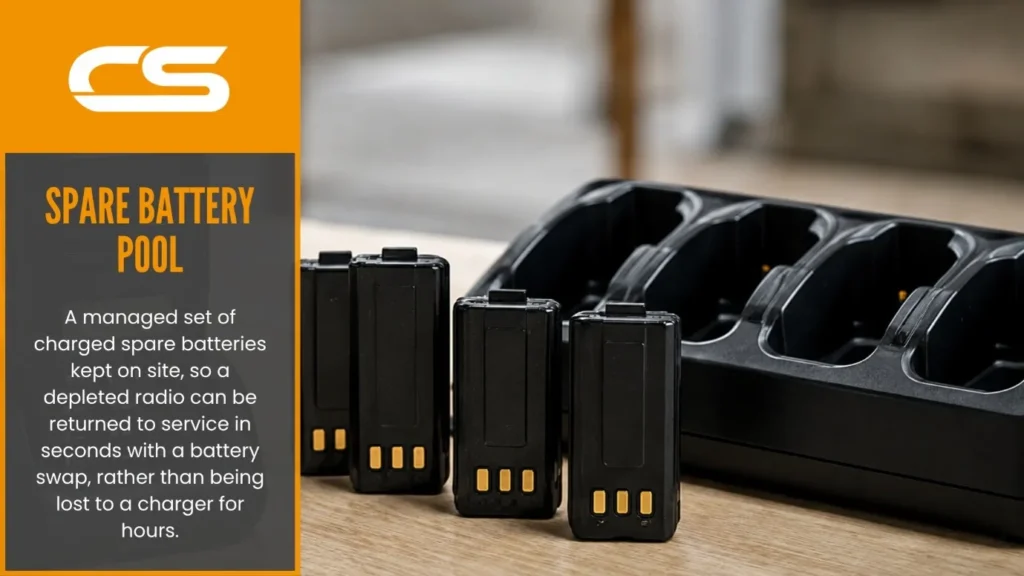
Run a spare battery pool so a depleted radio can be brought back into service in seconds by swapping a battery, rather than being lost to a charger for hours. For safety-critical roles this is essential, not optional.
Use multi-unit charging so a whole fleet is ready at the start of each shift, with a clear routine for who charges what and when. A rack of chargers with no ownership is just a rack of flat radios waiting to happen.
Rotate and retire batteries. Batteries are consumables. Tracking their age and replacing them before they degrade is far cheaper than a communication failure during a lift or an emergency.
This is the clearest example of a wider truth about radio systems: two identical handsets can deliver completely different real-world dependability, decided entirely by how charging and battery management are organised around them.
Reliability is designed, not bought
Coverage and battery reliability are not features you can pick off a shelf. They are the product of survey, design and a bit of operational discipline, matched to the specific site and the way the team actually works. That is the thread running through our guide to what construction sites need from a reliable communication system, and it is the difference between a system a site can depend on and a box of handsets that transmit noise until they go flat.
At Comms Spec, we survey, design and test coverage before work begins, and we build battery and charging management into the systems we supply, so the radios are ready when the site is. If you want communications that hold up across a large or growing site, through concrete and across a full shift, book a consultation and we will scope it around your project.