The right business communication system is not simply the radio with the longest quoted range or the longest feature list. It is the system that lets the right people communicate clearly, quickly and securely across the places they actually work, with enough resilience to keep operating when conditions become difficult.
For a small team on one contained site, that may be a straightforward set of professional handheld radios. A larger estate may need repeaters, indoor coverage infrastructure and a control point. A mobile or multi-site workforce may benefit from push-to-talk over cellular. Security-led operations may need encrypted communications, discreet audio and clear escalation paths. In some environments, a hybrid system is the most practical answer.
This guide sets out the questions to answer before you choose equipment, commit to a licence or decide whether to hire, purchase or deploy a longer-term managed system.
The six questions to answer first
- Where will people actually need to communicate: one room, one building, a large estate, multiple sites or vehicles on the move?
- What gets in the way: concrete, steel, basements, tunnels, plant, trees and vegetation, distance, noise or poor mobile coverage?
- How many people need access, and do they all need to hear the same traffic?
- How critical is communication to safety, security, service delivery or operational uptime?
- Does the communication system need to connect with alarms, CCTV, dispatch, GPS, access control or other operational platforms?
- Is the requirement temporary, variable or permanent?
Start with the operating environment, not the handset
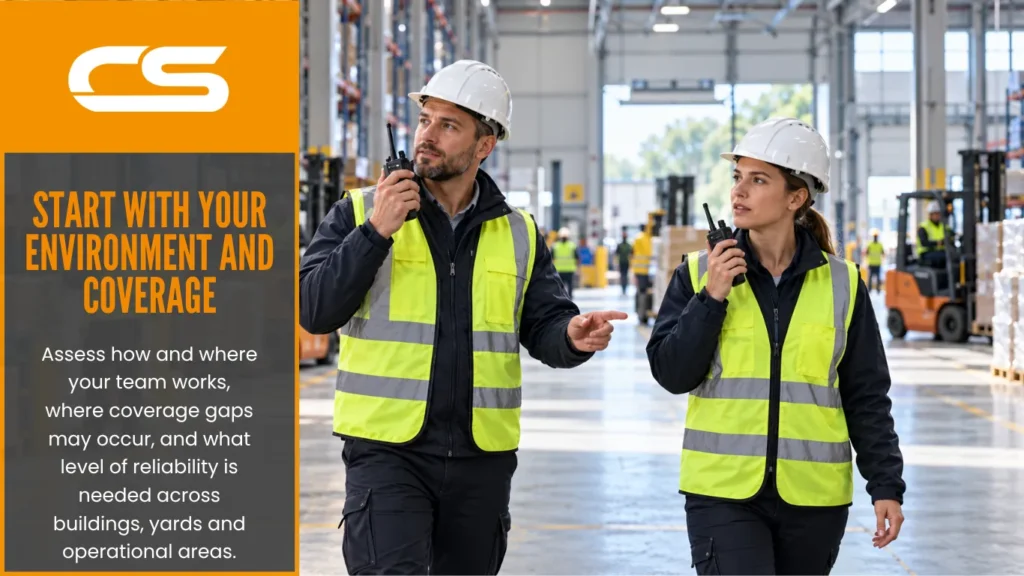
A communication system should be designed around the environment in which people work. The same device can perform very differently in an open car park, a reinforced concrete hotel, a warehouse full of racking, a construction project or a remote estate.
Before comparing products, map the physical and operational conditions that the system needs to tolerate.
- Indoor versus outdoor use, including basements, stairwells, plant rooms and service corridors.
- Building materials and physical obstructions, especially concrete, steel, glazing, dense walls, trees, vegetation and underground spaces.
- Noise levels and whether users will need headsets, remote speaker microphones or hearing protection-compatible audio.
- Weather, dust, moisture, temperature and the likelihood of drops or impacts.
- Public-facing environments where discreet communication matters.
- Areas where users cannot depend on public mobile coverage or local Wi-Fi.
- High-risk roles that may benefit from emergency buttons, lone-worker functions, man-down alerts or location information.
Comms-Spec designs two-way radio solutions around the complete communication environment, including devices, coverage infrastructure, configuration, training and support.
Define coverage in terms of real routes and critical areas
Coverage is one of the most common reasons communication systems disappoint. Published range figures rarely describe the actual site. Walls, metalwork, terrain, trees, vegetation, interference, user position and network design can all change performance.
Instead of asking “How far will this radio reach?”, ask “Where must this message get through every time?”
- Entrances, gates and perimeter routes.
- Loading bays, car parks and external compounds.
- Basements, lifts, stairwells and back-of-house corridors.
- Control rooms, reception desks and security posts.
- Warehouses, plant rooms and production areas.
- Remote buildings, outbuildings or separate sites.
- Vehicles and mobile teams travelling beyond the main site.
Common coverage architectures
| Approach | Where it may fit | What to verify |
|---|---|---|
| Direct radio-to-radio | Contained sites with modest coverage and traffic needs | Every required route, building and simultaneous-call requirement |
| Radio with repeaters or indoor antennas | Large estates, multiple buildings or difficult indoor areas | Engineered coverage, power resilience and usable network capacity |
| Push-to-talk over cellular (PoC) | Mobile teams, remote supervisors and widely separated locations | 4G/5G or Wi-Fi availability, subscriptions, service dependency and outage behaviour |
| Connected or hybrid system | Operations that need dependable local radio plus wider-area communication | Which functions cross the connection, system dependencies, security boundaries and fallback operation |
A professional coverage survey or live-site trial is often more useful than relying on theoretical range. For larger buildings and estates, the requirement may extend beyond handhelds to repeaters, antennas, base stations or distributed coverage infrastructure.
Size the system around people, roles and radio traffic
Team size matters, but the number of handsets is only part of the design. The more important question is how information should move between roles.
- Which roles need a device at all times?
- Which teams should have their own talk group or channel?
- Who needs to contact supervisors or a control room?
- Which messages are operational, which are security-sensitive and which are emergency traffic?
- Do users rotate across shifts, share devices or need personally assigned equipment?
- How many conversations may need to happen at the same time?
Putting every user on one channel can create as many problems as it solves. A clear channel or talk-group structure reduces unnecessary traffic and makes escalation easier. A hotel, for example, may need separate coordination for front-of-house, security, maintenance and events, while still allowing supervisors to connect those groups when required.
For hospitality environments, see Comms-Spec’s Hotels and Luxury Properties solutions for examples of discreet communications and integrated guest-safety systems.
Decide how independent the system needs to be
Traditional two-way radio and push-to-talk over cellular solve different problems. Neither should be treated as universally better.
Traditional two-way radio
Professional radio provides instant group communication without depending on any public mobile network, internet connection or outside service provider. That independence is its real advantage: the system belongs to you and stays under your control, so it keeps working if a mobile network or other outside service fails. For that reason, a self-contained radio system is a requirement of many site security protocols. It is particularly valuable where teams operate within a defined site, where mobile signal is unreliable, and wherever predictable local communication is critical.
Push-to-talk over cellular
Push-to-talk over cellular, often shortened to PoC, uses mobile data or Wi-Fi to provide radio-style group communication over much wider areas. It can suit distributed teams, travelling supervisors and operations spread across cities or regions, provided the supporting network is available. PoC also makes advanced features such as GPS tracking, voice recording, dispatcher consoles, instant messaging and multimedia file sharing far easier and much cheaper to add than on traditional radio systems.
Hybrid communication systems
Some operations need both. Local radio can support dependable on-site voice while PoC or other connected services extend communication to mobile teams, regional management or remote control functions. The key is to understand what happens if any supporting network, power source or connection is unavailable.
Where operations extend beyond conventional site infrastructure, Comms-Spec also provides remote connectivity solutions for land, maritime and remote environments.
Resolve licensing before deployment
Licensing should be considered early, not after equipment has already been bought. In the UK, some licence-exempt radios can be used within defined technical limits, while many professional business-radio deployments require an appropriate Ofcom licence.
The right route depends on the equipment, frequencies, coverage requirement and operating model. Licensing also does not, by itself, make communications private or encrypted.
- Whether the equipment is licence-exempt or requires an Ofcom Business Radio licence.
- Whether shared frequencies create an acceptable interference risk.
- Whether repeaters, base infrastructure or multiple locations change the licensing requirement.
- Who will hold and manage the licence over time.
- Whether the system will also be used internationally, where different national rules may apply.
For a practical overview, read Do You Need a Radio Licence in the UK? or speak to Comms-Spec about licensing support as part of the system design.
Think beyond voice: what should the system connect to?
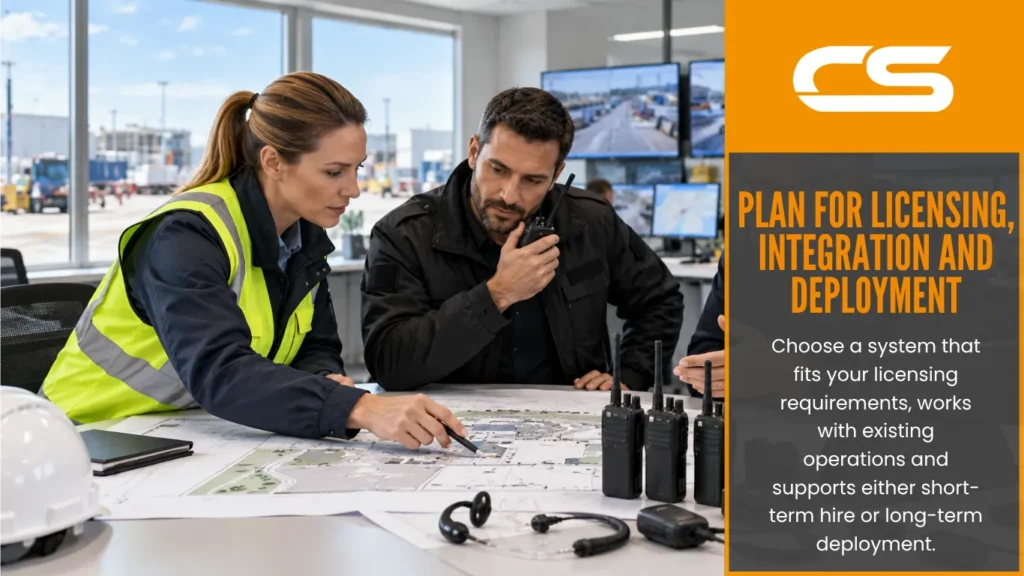
Modern communication systems can sit inside a much wider operational picture. If your teams already use CCTV, access control, alarms, tracking or incident-management tools, it is worth deciding whether those systems should remain separate or feed into a common response workflow.
- Emergency and panic alarms that need to reach the right team immediately.
- CCTV or perimeter alerts that should trigger a coordinated response.
- GPS or indoor location information for mobile staff and vehicles.
- Control-room or dispatch software for supervisors.
- Access-control events that require verification or intervention.
- Phone, VoIP or mobile users who may need to connect with radio teams.
- Automatic voice recording, incident logging and post-event review requirements.
Comms-Spec’s integrated security systems combine communications with technologies such as CCTV, access control, alarms and operational monitoring where a connected response is required.
Match the device and accessories to the job
Once the architecture is clear, device selection becomes much easier. The best handset is the one that fits the role, not the one with the highest specification on paper.
Questions to ask about devices
- How long does a normal shift last, and what battery strategy is needed?
- Do users wear gloves, protective clothing or hearing protection?
- Does the device need to be discreet or highly visible?
- Will it be used in rain, dust, heat, cold or hazardous areas?
- Does the user need emergency, lone-worker or man-down functionality?
- Do supervisors need displays, contact lists, messaging, GPS or dispatch integration?
- Would vehicle-mounted, desktop or control-room equipment improve the workflow?
Accessories should be treated as part of the system design. Earpieces, speaker microphones, chargers, spare batteries, carry solutions and control-room equipment can materially affect whether users adopt the system properly.
Choose between hire, purchase and long-term deployment
The right commercial model depends on how predictable the requirement is. Buying equipment is not always the most economical option, and hiring is not only for one-day events.
| Model | Best suited to | Things to consider |
|---|---|---|
| Short-term hire | Events, temporary projects, seasonal demand, trials and rapid deployments | Quantity changes, accessories, coverage equipment, licence arrangements and support during the hire period |
| Long-term hire / managed service | Operations that want predictable support and the ability to refresh or scale equipment | Service levels, replacement arrangements, ongoing programming, maintenance and contract flexibility |
| Purchase / permanent deployment | Stable requirements where the system will remain in use for several years | Capital cost, ownership of infrastructure, licensing, maintenance, spares, upgrades and internal responsibility |
For temporary or scalable requirements, see Comms-Spec’s Radio Hire service, which can include devices, accessories, repeaters, channel programming, licensing guidance and engineering support.
Build resilience into the specification
If communication is important during normal operations, it becomes even more important when something goes wrong. Resilience should therefore be designed in rather than added later.
- Battery capacity and charging arrangements for extended shifts.
- Spare devices and fast replacement for failures or damage.
- Coverage redundancy in areas where a dead spot would create unacceptable risk.
- Backup communication paths if a network or site connection is lost.
- Power resilience for repeaters, gateways and control-room equipment.
- Clear fallback procedures that users understand before an incident occurs.
- Ongoing maintenance, firmware management and technical support.
Where continuity is critical, ongoing radio repairs and technical support should be considered part of the operating model, not just an after-sales service.
Give suppliers an operational brief, not a shopping list
A useful supplier brief describes what the organisation needs to achieve. It should not begin with a preferred radio model unless that choice has already been validated.
Include these details in your communication-system brief
- Site or operating-area description, including maps or floor plans where available.
- Critical coverage areas and known dead spots.
- Number of users, shifts and job roles.
- Expected channel or talk-group structure.
- Noise, weather, dust and other environmental constraints.
- Safety and security features required.
- Existing radio equipment or infrastructure that may need to be retained.
- Integration requirements with CCTV, alarms, access control, dispatch or mobile systems.
- Licensing status and geographic operating area.
- Desired deployment date and whether hire, managed service or purchase is preferred.
- Support expectations, including out-of-hours requirements.
A simple decision framework
| If this sounds like your operation… | Start by exploring… |
|---|---|
| Small team, contained site, straightforward coverage | Professional handheld radios with a simple channel plan |
| Large building, estate or site with difficult indoor areas | Engineered radio coverage, repeaters and/or indoor antenna infrastructure |
| Mobile workforce spread across towns, regions or multiple sites | Push-to-talk over cellular or a hybrid architecture |
| Security-led environment with sensitive traffic | Encrypted-capable communications, discreet audio and structured escalation |
| Temporary event, project or seasonal operation | Radio hire with pre-programmed channels, accessories and coverage support |
| Permanent high-availability operation | Designed system with licensing, maintenance, resilience and long-term support |
Common mistakes to avoid
- Buying devices before checking the actual coverage requirement.
- Treating quoted range as a substitute for a site survey or realistic testing.
- Putting every user on one channel without considering traffic and escalation.
- Leaving licensing until the system is ready to go live.
- Choosing PoC for wide-area reach without checking network availability and outage behaviour.
- Ignoring batteries, accessories, charging and user ergonomics.
- Failing to plan how communications interact with wider security and operational systems.
- Focusing only on purchase price rather than support, resilience and total operating cost.
- Buying cheap radio equipment without considering longevity, then losing the saving on early replacements and servicing.
Choose the system around the operation
The best communication system is not the most complicated one. It is the one that gives your teams dependable communication where they need it, separates routine traffic from critical messages, fits the environment and remains supportable over the life of the operation.
For some businesses, that means a compact radio fleet. For others, it means repeaters, dispatch, PoC, connected security systems or a hybrid architecture. The important part is to make those decisions from the operational requirement backwards.
Planning a new system or reviewing an existing one? Comms-Spec can assess your users, environment, coverage and integration needs, then recommend a right-sized communication architecture rather than a one-size-fits-all product list.
Frequently Asked Questions
There is no single best system for every business. The right choice depends on the operating environment, required coverage, number and type of users, criticality, licensing, integration needs and whether the requirement is local, wide-area or hybrid.
For instant group communication, professional radios can be faster and simpler because users do not need to dial or navigate an app. They can also operate independently of public mobile networks in many configurations. Phones remain useful for longer conversations, data-heavy workflows and applications, so the best solution may use both. Hybrid radios combine the two, working as both a two-way radio and a mobile phone in a single device.
PoC can be a strong fit where teams are widely dispersed and reliable mobile or Wi-Fi connectivity is available. It is particularly useful for mobile supervisors, transport and multi-site teams. The main design question is how the operation should behave if the supporting network becomes unavailable.
Some licence-exempt equipment can be used within specific technical limits. Many professional business-radio systems require an appropriate Ofcom licence. The licensing route should be confirmed before deployment, particularly where repeaters, controlled frequencies or larger networks are involved.
No. Hire can suit events, temporary projects, seasonal demand, trials, changing workforce sizes and longer-term managed deployments where the organisation wants flexibility rather than outright ownership.
A repeater may be appropriate when direct radio-to-radio coverage cannot reliably reach all critical areas, such as large estates, multi-floor buildings, basements or separated buildings. The decision should be based on coverage testing or an engineered survey rather than distance alone.