“Are you on channel?” is a question you shouldn’t hear in 2025. The modern workforce is dispersed, mobile and time-pressed; they need one-press voice that just works wherever the job takes them. Push-to-Talk over Cellular (PoC) delivers exactly that, instant group communication using the reach of public 4G/5G and Wi-Fi, without the cost or complexity of building and maintaining private radio infrastructure.
This guide explains how PoC technology works, where it outperforms traditional land mobile radio (LMR), where a hybrid approach makes sense, and the practical steps to plan, pilot and scale PoC with confidence. You’ll get frameworks, real-world scenarios and checklists you can take straight into vendor demos and board discussions.
Why Push-to-Talk over Cellular matters now
Three converging pressures have pushed PoC to the top of comms roadmaps:
- Coverage expectations have changed. Operations span cities and countries. Staff hop between venues, depots and client sites. National (even international) coverage with consistent user experience is now a baseline, not a nice-to-have.
- Duty of care and auditable comms. Lone working and incident management demand reliable emergency functions, location awareness and recorded communications. PoC platforms make it far easier to centralise logs, administer permissions and surface post-incident evidence.
- Digital service integration. Teams aren’t just talking. They’re sharing jobs, statuses, photos, video, and integrating with dispatch, access control and ticketing. PoC’s app-centric design and APIs let you connect voice with the rest of your operational stack.
For brand, marketing and comms leaders, this isn’t just technology, PoC is an experience your customers and stakeholders feel: faster responses, calmer coordination and a consistent, on-brand service.
What is Push-to-Talk over Cellular (PoC)?
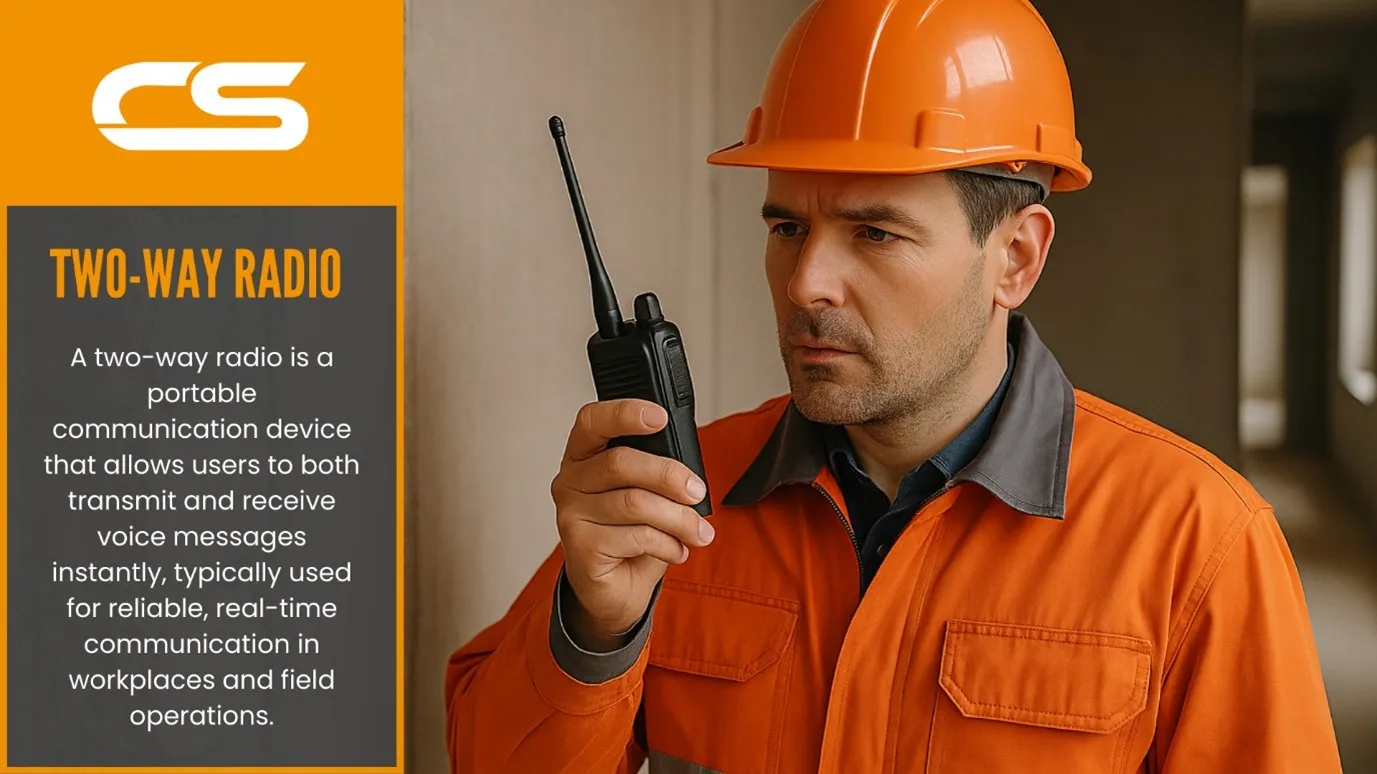
At its simplest, PoC communication replicates two-way radio’s “press, speak, everyone hears” model over IP networks, 4G/5G and Wi-Fi, using dedicated PoC handsets or rugged smartphones with a tactile PTT button. A cloud or on-premise server handles talkgroups, call control, encryption, recording, and user management. Modern platforms add mapping/locations, emergency/man-down, text/photo/video messaging, dispatch consoles, and APIs to integrate with other systems.
Think of PoC as the “radio user experience” delivered through the ubiquity of cellular coverage and the flexibility of apps.
How PoC technology works
- Devices: Dedicated PoC radios (with top-mounted PTT, loud front speakers, long-life batteries) or rugged smartphones with PTT side keys. Many support accessories, remote speaker mics, covert earpieces, vehicle kits.
- Networks: Primarily public 4G/5G; can also use Wi-Fi on trusted networks to save data and improve indoor coverage. Some platforms support network QoS features and SIM provisioning policies to stabilise performance.
- Platform (application server): Manages user accounts, talkgroups, priority levels, recording, encryption, presence (online/offline), location services, geofencing and dispatch. Often cloud-hosted for simplicity; on-prem options exist for higher control.
- Control & dispatch: Web or native consoles for supervisors, live maps, emergency pop-ups, call history, user lockdown (stun/kill), and quick creation of ad-hoc incident talkgroups.
- Security: Encrypted signalling and media streams, role-based access, device binding, and remote wipe. MDM (mobile device management) can lock devices into a kiosk mode so the PTT app is always foreground.
The 10 core PoC benefits (with field examples)
1) Wide-area coverage without building infrastructure
PoC rides on public 4G/5G and your existing Wi-Fi.
Example: A retail chain adds seasonal staff and pop-up kiosks nationwide. New users come online in hours, no repeaters, no frequency planning.
2) Rapid deployment and scaling
Provision a device image, push a profile, assign talkgroups, done.
Example: An events agency scales from 50 to 300 users for a month-long festival, then back down the week after.
3) Lower upfront cost, predictable Opex
Minimal capex; per-user licensing and data plans are easy to forecast.
Example: A logistics firm shifts capex to opex, aligning comms cost to headcount and peak seasonality.
4) Easy cross-company collaboration
Invite contractors, partners or emergency services into temporary talkgroups with controlled permissions and expiry.
Example: A stadium’s in-house team and visiting riggers share a “Load-in” group for 48 hours, then access auto-revokes.
5) Richer operational toolkit
Photos, short video clips, job tickets, statuses, forms, and location breadcrumbs complement voice.
Example: A facilities team sends a leak photo alongside a call; control routes the right contractor first time.
6) Centralised recording and audit trails
Calls, messages and alerts are automatically indexed by time, user and talkgroup.
Example: After a crowd incident, security exports the relevant audio and location timeline for investigators in minutes.
7) Fine-grained control and remote management
Change talkgroups, push updates, lock down or stun/kill a lost device, over the air.
Example: A contractor leaves site without returning a handset; ops disables it and reassigns the licence instantly.
8) Device choice and ergonomics
Pick dedicated PoC radios (loud, glove-friendly, long battery) or rugged smartphones (apps, cameras).
Example: Front-of-house uses compact PoC handsets; maintenance uses camera-equipped rugged phones for visual reporting.
9) Indoor coverage via Wi-Fi offload
Where cellular struggles (deep indoors), PoC leverages enterprise Wi-Fi.
Example: In a hospital basement, handsets roam to Wi-Fi automatically, no change to user behaviour.
10) Future-ready features
5G brings better uplink, lower latency and network features like QoS that PoC platforms can exploit.
Example: A port plans to stream short “see-what-I-see” clips during incidents without disrupting voice.
Security, privacy and compliance considerations
- Encryption and identity. Ensure end-to-end encryption for media and signalling. Bind accounts to devices; use MFA for dispatch consoles. Disable “guest” devices after defined periods.
- Recording and retention. Align retention policies with regulation and risk appetite (e.g., 30/90/365 days). Ensure role-based access to playbacks and a clear export process for investigations.
- Location permissions. Many organisations only need zone-level indoor location. Balance precision with privacy, especially for unions and contractor agreements. Make location opt-in for non-critical teams.
- MDM & kiosk. Lock devices to the PoC app and essentials (dialler, camera) to avoid “app sprawl”. Disable OS updates during peak events.
Building resilience into PoC
- Dual-path connectivity. Prefer devices with dual-SIM (two networks) and Wi-Fi. Set intelligent failover policies.
- On-site Wi-Fi hardening. For critical areas, invest in robust enterprise Wi-Fi with coverage in stairwells, basements and back-of-house corridors. Prioritise PTT traffic on the LAN where possible.
- Hybrid with LMR for the “red list”. If you have tunnels, lift shafts, or RF-hostile zones, maintain a small LMR layer for those areas, bridged to PoC so teams stay coherent.
- Offline behaviour. Define what users see when the network drops (e.g., “No network, try Wi-Fi” prompts). Train staff to move to known coverage spots during incidents.
Real-world scenarios
Event control across multiple venues
A promoter runs simultaneous concerts in three cities. With Cellular push-to-talk, they keep one “Command” group for emergencies and per-venue Ops groups. Contractors gain temporary access via QR invite; access expires 24 hours after load-out. All emergency presses escalate to Command with priority interrupt and live location.
Utilities maintenance with lone workers
Field engineers move between remote sites, laybys and substations. Dual-SIM PoC devices roam between networks; where cellular dips, devices latch onto depot Wi-Fi. Lone worker timers and man-down alerts push to regional dispatch with breadcrumb trails for faster response.
Retail and security collaboration
A shopping centre blends in-house security on PoC radios with store detectives on rugged smartphones. A hybrid gateway shares critical broadcasts to legacy LMR used by older tenants. Incident talkgroups enable short-term, recorded cooperation without long-term access creep.
Conclusion
PoC advantages aren’t just technical, they’re strategic. You gain wide-area, on-demand voice with rich context (location, media, status) and centralised control. You reduce the operational drag of infrastructure while increasing your ability to scale, integrate and audit. For many organisations, a hybrid approach delivers the best of both worlds: LMR where physics demands it; PoC everywhere else. Ready to see PoC in your world? Tell us about your sites, shifts and incident scenarios, and we’ll design a hands-on pilot, device trials, Wi-Fi walk-tests and live emergency drills, with a plan to scale.
Contact Comms-Spec and let’s build a reliable, audit-ready push-to-talk estate that keeps your teams safe, responsive and on brand.