Remote communication is essential for field engineers, survey teams and remote workers, but these are often the exact locations where normal mobile connectivity struggles the most. In the UK, Ofcom’s latest Connected Nations report shows that even with all mobile operators combined, 5G coverage still does not reach every area, and coverage from a single operator can vary widely between regions. This makes it vital to plan for resilient communication solutions such as long-range radios, satellite communication, and practical operating strategies.
Comms-Spec has supported organisations for over 30 years with secure two-way radio systems, equipment hire, and engineering expertise. About Comms-Spec
The remote and harsh-environment challenge
Remote work can present a number of barriers to reliable communication:
- Terrain can block signals. VHF, UHF, and microwave signals typically require a clear line of sight. Hills, dense forest, or buildings can block or weaken signals. Raising antennas or using repeaters can help extend coverage.
- Weather can cause problems. At certain frequencies such as Ku and Ka bands, heavy rain or wet snow can reduce signal strength. Systems can be designed to mitigate this through additional signal margin, adaptive coding, and using multiple sites.
- Equipment must be rugged. In challenging environments, devices should meet appropriate IP ratings (such as IP67) to prevent dust or water ingress, and ideally comply with MIL-STD-810 standards for shock, vibration, and temperature resistance.
- Safety for lone workers. In the UK, employers have a duty to keep lone workers in contact and able to raise the alarm in an emergency.
Example:
Imagine a maintenance crew repairing a power line deep in a national park. Mobile phone coverage is patchy, weather conditions are unpredictable, and the crew needs to coordinate across several kilometres of rough terrain. Without a resilient communication plan, they could quickly find themselves isolated and unable to report an incident or receive instructions.
Remote location solutions
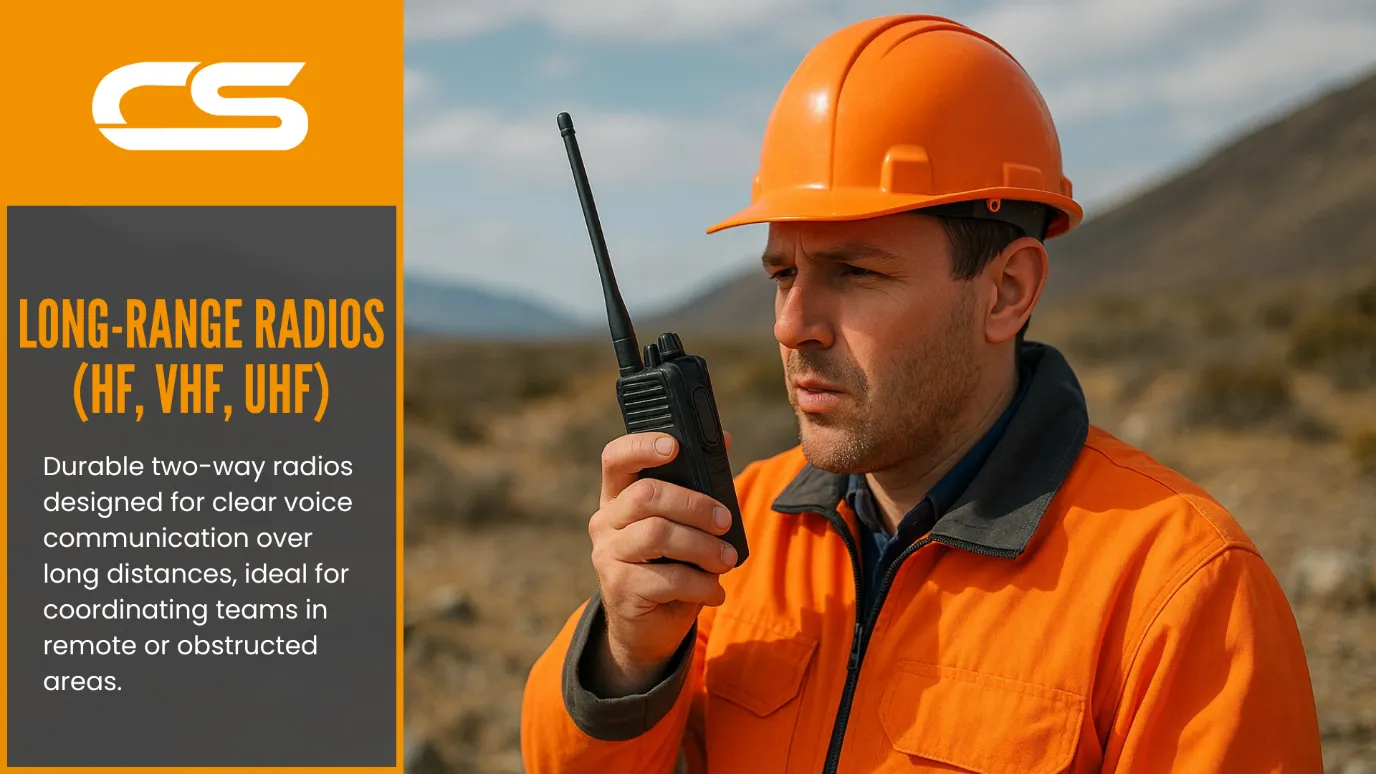
1. Long-range radios (HF, VHF, UHF)
When mobile networks are unreliable or completely absent, long-range radios provide a dependable way to keep teams connected. They work independently of public infrastructure and can be tailored to suit a wide range of distances and terrain. From coordinating staff on large industrial sites to linking teams across mountain ranges, the right radio system can be a lifeline.
When to use: For voice-focused operations, daily team coordination, push-to-talk (PTT) functions, and beyond-line-of-sight communication without depending on third-party networks.
- HF (3–30 MHz): Can cover regional to intercontinental distances without satellites. It can use NVIS (Near Vertical Incidence Skywave) to work effectively in mountainous or forested terrain.
- VHF/UHF (≈30 MHz–1 GHz): Good for short to medium range with clear audio quality. Works best with a direct line of sight and can be extended using repeaters or temporary masts.
Example:
A construction team on a remote wind farm uses VHF radios to coordinate between turbine sites. Positives include instant communication and reliability without mobile coverage. Negatives include the need for repeaters in hilly areas and licensing requirements for more powerful equipment.
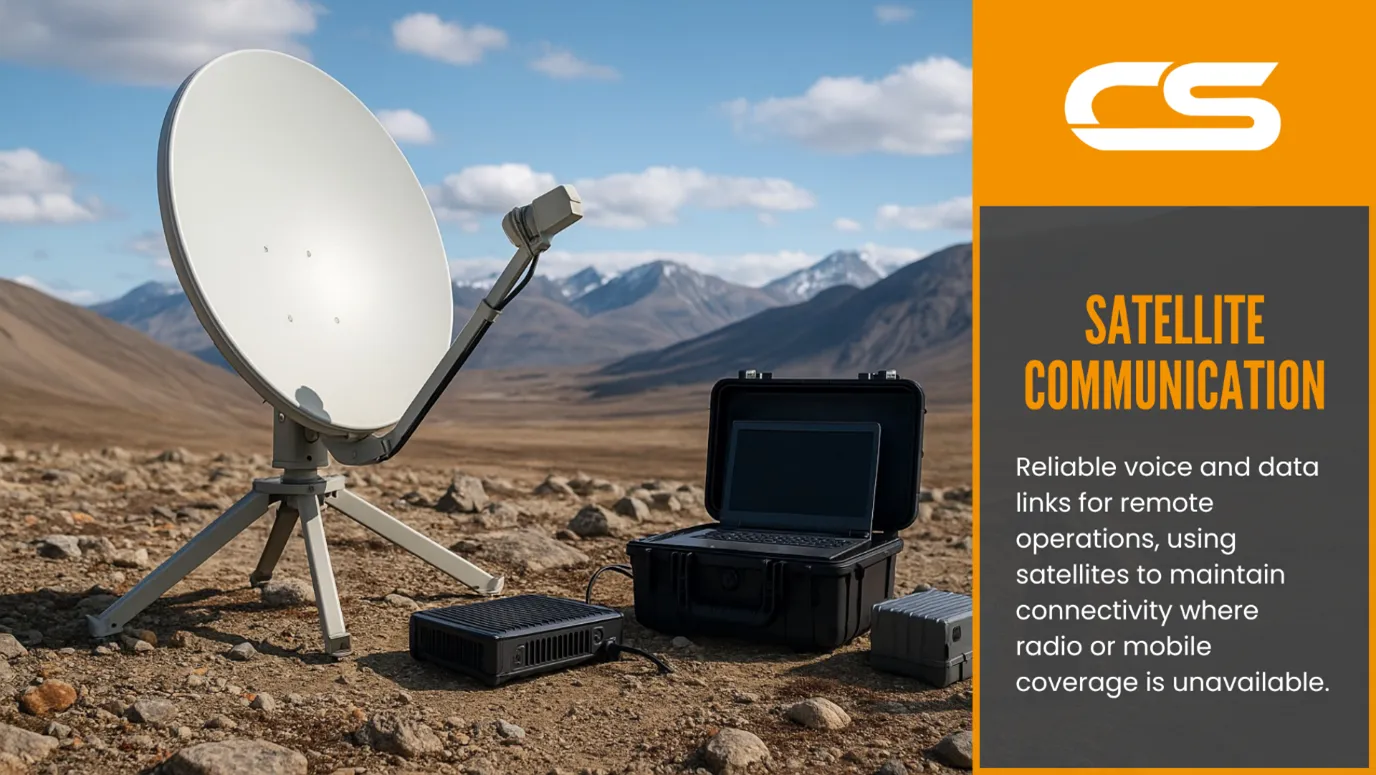
2. Satellite communication (LEO, GEO)
If you are working in the middle of the ocean, at the poles, or deep in rural areas where even radio repeaters cannot reach, satellite communication offers a direct link to the rest of the world. By connecting through satellites in orbit, these systems provide voice, data, and emergency signalling anywhere on Earth, provided the equipment has a clear view of the sky.
When to use: For areas with no terrestrial coverage, for high-volume data backhaul, remote monitoring, or wide-area PTT.
- GEO satellites: Located about 35,786 km above the equator. They provide consistent coverage over large areas but have higher latency.
- LEO constellations: Examples include Starlink and OneWeb. They orbit closer to Earth, which results in much lower latency. This makes them ideal for IP-based services and applications that need near real-time response.
Example:
A polar research team uses Iridium (LEO) satellite phones for voice calls and Inmarsat (GEO) terminals for data links. Positives include true global coverage with Iridium and dependable fixed-point connections with Inmarsat. Negatives include higher latency with GEO services and the need for a clear view of the sky for both systems.
3. Useful field communication tools
Even with strong primary systems in place, certain environments require extra measures to keep signals flowing. Portable repeaters, high-gain antennas, rugged accessories, and locator beacons can significantly boost reliability and safety. These tools act as performance enhancers, filling gaps and providing extra security for people working in unpredictable conditions.
- Portable repeaters: These act as signal boosters that can be set up on-site to extend radio coverage into hard-to-reach places such as valleys, tunnels, and large buildings. They are especially valuable for temporary sites or events where fixed infrastructure is not available.
- High-gain antennas: These antennas are designed to focus the radio signal in a specific direction, increasing both range and clarity. They are useful for point-to-point links between two fixed locations or to improve reception in fringe coverage areas.
- Rugged accessories: Items such as weatherproof headsets, heavy-duty microphones, and extended-life batteries help keep communication equipment working in harsh conditions. This ensures that devices remain usable during long shifts in rain, dust, heat, or freezing temperatures.
- Personal Locator Beacons (PLBs): These are small, portable devices that send a distress signal via the Cospas-Sarsat satellite network when activated. They are vital for lone workers or teams in remote locations because they allow rescuers to quickly pinpoint the person’s location anywhere in the world.
Example:
A survey team working in a mountainous region deploys a portable repeater to maintain constant contact between crews in different valleys. Positives include reliable local coverage and easy redeployment. Negatives include the need to transport, power, and maintain the equipment.
Building a resilient remote communication plan
A strong remote communication plan requires careful preparation. Here is a practical, step-by-step approach.
1. Survey coverage and risks
Map mobile and radio coverage and note terrain blockages or possible weather-related issues.
- Example: A civil engineering company in rural Scotland discovers that a deep valley blocks mobile signals, so they plan to use portable repeaters from the outset.
- Tip: Use free mobile coverage checkers, but also test radio and satellite gear on-site.
2. Select a main and backup system
Always choose a primary communication tool and a backup in case it fails.
- Example: An offshore wind farm uses VHF radios for daily work and Iridium satellite phones for emergencies.
- Positive: Ensures continuity even if the main system fails.
- Negative: Involves additional cost and training.
3. Match equipment to the environment
Choose devices with suitable IP and durability ratings.
- Example: A mining team uses MIL-STD-810 tested radios with waterproof headsets.
- Tip: Consider extremes such as flooding, freezing, or dusty conditions.
4. Plan for weather effects
High-frequency satellite systems can be affected by heavy rain, so have an alternative ready.
- Example: A disaster relief team uses Starlink for high-speed data and Inmarsat L-band for storm-proof backup.
- Positive: High-speed performance with reliable fallback.
- Negative: Requires transporting two systems.
5. Ensure power resilience
Remote sites may lack mains power.
- Example: A pipeline crew runs repeaters on solar panels with battery backup.
- Tip: Keep spare charged batteries and consider portable generators.
6. Address licensing and security
UK business radios usually require Ofcom licensing, and sensitive work may need encryption.
- Example: A private security firm uses encrypted digital radios under a Simple Site licence.
- Tip: Apply for licences well before operations begin.
7. Train your team
Staff must know how to operate both main and backup systems.
- Example: A mountain rescue team practises switching between VHF, HF, and satellite every quarter.
- Positive: Keeps skills fresh.
- Negative: Requires regular time away from other duties.
Let Comms-Spec Build and Maintain Your Communication Plan
Creating a reliable remote communication plan takes expertise, the right equipment, and ongoing support. Comms-Spec can handle every stage of the process for you. Our team will assess your site, recommend the most effective combination of technologies, and supply equipment that is ready for the conditions you face.
We do more than just design your system. Our engineers will set up and configure your radios, satellite devices, and supporting tools on-site, ensuring everything works from day one. We can also train your team so they feel confident using the equipment and switching between main and backup systems when needed.
Once your system is up and running, we offer ongoing maintenance and 24/7 technical support so you can stay connected at all times. Whether you are working on a construction site, operating in a remote industrial facility, or leading an expedition, we can make sure your communications are robust, secure, and fit for purpose. Contact our team today to start building your tailored remote communication plan.