
Drive-Through Vehicle & Cargo Scanners
High-throughput drive-through scanning for cars, trucks, vans and cargo — designed to support strong detection at busy checkpoints where stopping every vehicle isn’t practical.
Why Vehicle X-Ray Scanning is a security multiplier
Vehicle X-ray scanning strengthens frontline security by turning inspections into a consistent, repeatable process — allowing teams to detect threats while maintaining operational flow.
Faster, More Reliable Inspections
Reduce reliance on manual searches and inconsistent checks.
Stronger Detection Confidence
Reveal concealed items in cargo areas and vehicle structures.
Higher throughput with control
Maintain flow at busy checkpoints while improving security.
Better Response to Evolving Threats
Detect a broad range of contraband and suspicious loads.
Support Compliance and Verification
Improve cargo verification and help identify trade fraud.
Deploy to Match the Mission
Fixed portals, gantries, rail systems, handheld or mobile platforms.
Mobile & Specialist Inspection Tools
When threats don’t stay in one place, inspection tools can’t either. These systems extend screening beyond fixed checkpoints — for rapid response, remote operations and hard-to-access inspection targets.
Designed around your threat model and throughput
From ports and borders to events and critical infrastructure, the right scanning solution depends on what you’re protecting, what you’re processing, and what you can’t afford to miss. Comms-Spec helps you align performance, deployment and outcomes.
High throughput
We help you implement scanning that supports fast vehicle processing while maintaining strong detection — reducing disruption without lowering standards.
Risk reduction
We align the inspection approach to your threat profile (weapons, explosives, drugs, contraband and hidden persons) so teams can prioritise what matters most.
Fixed checkpoints
For permanent control points, we support solutions like portals, gantries and rail scanning to deliver consistent screening as part of day-to-day operations.
Mobile operations
For changing sites and surge requirements, we deploy mobile and high-energy options that bring scanning to where the risk is — not just where the infrastructure is.
Hard-to-reach areas
We support specialist inspection where conventional scanners can’t operate — including handheld imaging for tyres, interiors and confined spaces.
Cargo verification
We support screening that strengthens cargo assurance and manifest verification — improving control and helping identify suspicious loads.
Better detection, less disruption
Vehicle X-ray scanning is most effective when it’s engineered around real operations — throughput, environment, and the consequences of a missed threat.
Throughput vs security
When queues grow, pressure builds to rush inspections. That’s when risk rises — because inconsistent checks and manual searches become the norm, and the chance of missing concealed contraband increases.
Drive-through portals and high-performance imaging systems make high-throughput screening more effective by scanning vehicles and cargo quickly, with imaging designed to support faster assessment.
How Comms-Spec adds value: We help you select the right system for traffic volume and vehicle types, then shape deployment around your checkpoint workflow so you maintain both pace and control — without turning security into a bottleneck.
Dense cargo visibility
Dense, mixed or high-volume cargo can hide anomalies in plain sight. If imaging isn’t clear enough, operators lose confidence — and the response becomes slow, inconsistent, or overly reliant on manual intervention.
High-energy and cargo-focused systems are built to inspect pallets, containers and heavy loads more effectively, supporting safer, more reliable inspection of air cargo and freight.
How Comms-Spec adds value: We match the scanning approach to the cargo reality (not the brochure), helping teams get usable images for decision-making and a setup that performs under daily operational pressure.
Remote & changing sites
Threats and operations aren’t always based at fixed infrastructure. Events, temporary checkpoints, remote borders, or shifting port operations can leave gaps where fixed scanners can’t be installed or used.
Mobile X-ray inspection systems and mobile high-energy platforms bring scanning capability to where it’s needed — enabling screening in locations other systems can’t reach.
How Comms-Spec adds value: We help you deploy mobile screening as a dependable capability (not a one-off), aligning configuration to your mission, movement and inspection targets so performance remains consistent in the field.
Hidden persons detection
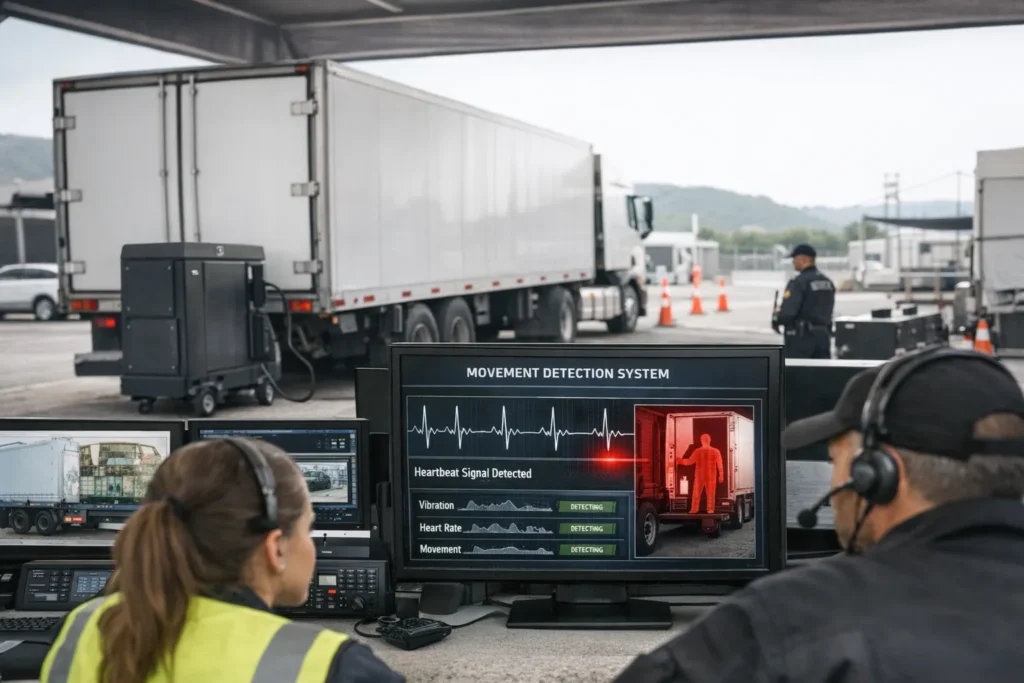
Standard inspection can miss one of the highest-risk scenarios: concealed people hidden inside vehicle interiors or cargo areas. Even thorough searches can fail when concealment is deliberate and time is limited.
Movement Detection Systems identify signs of a hidden person using passive, non-invasive measurement — capable of detecting low signals such as a heartbeat.
How Comms-Spec adds value: We integrate hidden-person detection into a broader screening strategy, so teams can combine imaging and detection methods for stronger outcomes, quicker escalation decisions, and safer interventions.
36+ years supporting high-risk environments
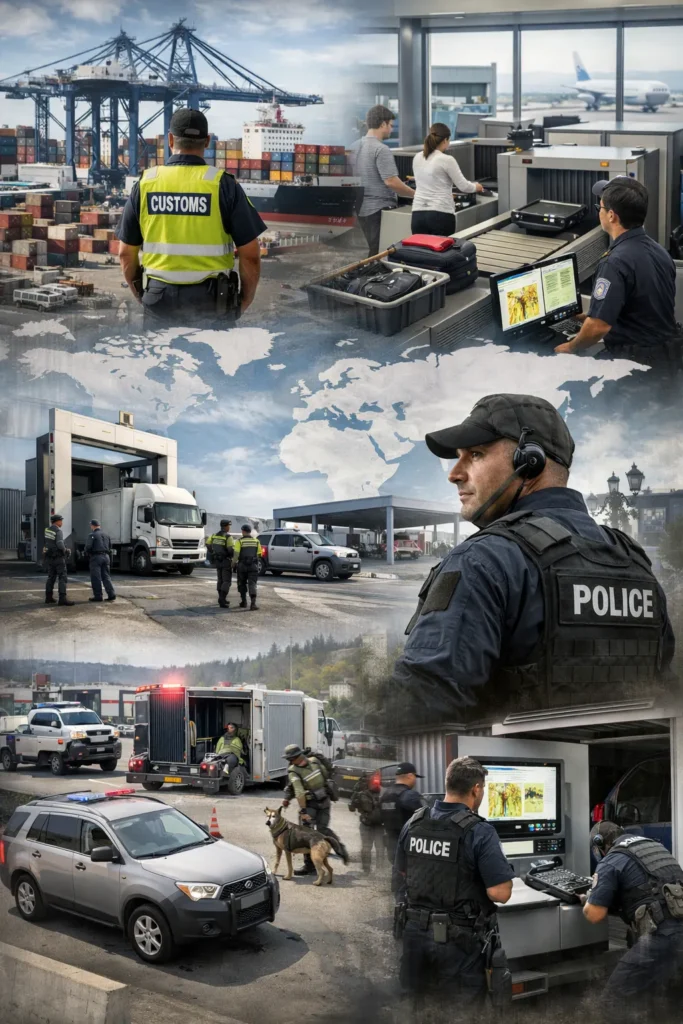
For more than three decades, Comms-Spec has helped customers worldwide combat terrorism, smuggling, trade fraud and illegal immigration — supporting security operations across aviation, defence, law enforcement, ports, customs and critical infrastructure.
Add hidden-person detection to your screening layer
Public places, transport networks, prisons and government sites face evolving threats — and vehicles are a common vector. Movement Detection Systems add a critical layer by identifying concealed occupants inside vehicles or cargo areas using a passive, non-invasive method — supporting safer, faster decision-making at the checkpoint.
Related Solutions
High-throughput drive-through scanning for cars, trucks, vans and cargo — designed to support strong detection at busy checkpoints where stopping every vehicle isn’t practical.

Natural Resource

Ports

Commercial Marine
Frequently Asked Questions
- Is X-ray scanning safe for operators and drivers?
Vehicle X-ray systems use controlled radiation to produce high contrast images of a vehicle’s contents and structure. They are used at ports, distribution hubs, secure facilities, critical infrastructure and event perimeters where rapid, reliable screening is required.
Common formats include:Fixed portals or drive-through gantries for high throughput lanes.
Relocatable or mobile systems on trailers or trucks for seasonal or temporary sites.
Transmission imaging for deep penetration through dense cargo.
Dual-energy imaging to help distinguish organic from inorganic materials and highlight suspicious density changes.
Comms-Spec recommends the format and energy level based on your risk profile, space, throughput targets and regulatory requirements.
- What throughput can we expect at a checkpoint?
es, when operated correctly under an approved radiation protection plan. Safety is managed through:
Controlled areas and interlocks that prevent exposure during scanning, with traffic lights, barriers and occupancy sensors.
Operational policy that scans unoccupied vehicles unless a system is explicitly certified for occupied scanning and local regulation permits it.
Shielding and dose control so scattered radiation remains within recognised limits at the site boundary.
Training and governance including a Radiation Protection Adviser or equivalent, operator training, local rules, signage and routine safety checks.
ALARA practice keeping exposures as low as reasonably achievable while meeting inspection goals.
We document safe working distances, emergency stops and routine audits, and we verify safety devices during commissioning and maintenance.
- Can images be analysed automatically?
Throughput and image clarity depend on system type, inspection depth and operating mode.
Throughput ranges from dozens to several hundred vehicles per hour, depending on lane design, scan speed and the proportion sent to secondary inspection.
Image quality is set by energy, detector resolution and motion control. Dual-energy and advanced processing improve material separation and edge definition.
Penetration is selected to suit your cargo mix so dense pallets and vehicle frames are still readable.
Lighting and motion controls reduce blur and ensure consistent results in day, night and poor weather.
Acceptance tests confirm your target throughput and prove that critical details are visible at agreed checkpoints on a test vehicle.
- Can images be analysed automatically?
Detection is a combination of trained operators and automated aids.
Operator tools include variable zoom, contrast, colour overlays for dual-energy, region marks and measurement cursors.
Assisted analysis uses algorithms to flag density anomalies, concealment patterns or shapes of interest, while leaving final judgment to trained staff.
Multi-sensor context links scans with ANPR, weight-in-motion and manifest data so inconsistencies are highlighted automatically.
Quality controls such as daily image quality checks, calibration phantoms and random blind reviews maintain accuracy.
Procedures define when to route to secondary inspection and how to minimise unnecessary delays.
Comms-Spec provides operator training, proficiency testing and periodic refreshers to keep detection performance high.
- Do systems work in harsh weather or 24 hour operations?
Integration streamlines decisions and preserves a clear audit trail.
Gate logic ties scan results to barriers, traffic lights and turnstiles, with rules for pass, hold or secondary inspection.
ANPR and manifests link number plates, driver details and consignment data to each image set.
Security platforms receive alerts and snapshots, while the full image record is archived in the evidence store.
Incident workflows create cases with timestamps, operator notes and attachments.
Data protection is handled with role based access, encryption at rest and in transit, and retention policies that match your governance. Images that could reveal personal effects are treated as sensitive data.
Evidence exports include hash verification and chain of custody fields for investigations or enforcement.
- Can scans be archived and audited?
Planning and lifecycle care keep performance predictable and audit ready.
Space and civils: fixed portals require a straight, level approach, defined exclusion zones, signage and suitable turning space. Mobile systems need hardstanding for stabilisers and a safe traffic plan.
Power and resilience: clean power supply sized for the scanner, UPS for control electronics, and optional generator integration at remote sites.
Environmental protection: weather-rated enclosures, drainage and wind load considerations for gantries, with regular lens and detector cleaning.
Preventive maintenance: scheduled inspections, calibrations, firmware updates and safety interlock tests, with documented results.
Regulatory compliance: approvals or notifications to the relevant authority, radiation risk assessments, local rules, staff dosimetry if required, and periodic audits.
Support: remote diagnostics, spares, and target response times for faults, plus refresher training and performance reviews.
Comms-Spec supplies design drawings, safety documentation, acceptance records and service reporting so you can demonstrate compliance and maintain reliable operations.