
VSAT Solutions
VSAT (Very Small Aperture Terminal) delivers reliable two-way satellite connectivity using compact ground stations — enabling secure voice, data and video communications in remote or underserved locations, without terrestrial dependencies.
Why Satellite Connectivity pays off in the real world
Satellite connectivity gives you the freedom to operate, respond, and support people in locations where standard networks can’t be trusted — or don’t exist.
Global Reach
Connect remote sites, vessels and teams without relying on local infrastructure.
Business Continuity
Keep communications running during outages, disasters or network overload.
Modern Broadband
Support data-heavy operations with high-throughput satellite services.
Resilient by Design
Hybrid and multi-orbit approaches reduce single points of failure.
Better welfare & collaboration
Enable real-time comms for dispersed teams.
Deploy where needed
Fixed installations, on-the-move capability, or portable kits.
Satellite Phones for off-grid voice and SOS
Satellite phones provide essential voice, text and low-bandwidth data services in remote, off-grid or disaster-stricken areas — connecting directly to orbiting satellites rather than cell towers.
A satellite solution that’s designed around your reality
Satellite connectivity works best when it’s engineered for the environment, the application, and the consequences of downtime. Comms-Spec delivers an end-to-end service — from design to deployment to ongoing support.
Remote locations
We design satellite-first connectivity that bypasses terrestrial infrastructure — selecting the right solution (VSAT, LEO, hybrid or satphones) for where and how you operate.
Rapid deployment
We provide portable and rapid-deploy connectivity for temporary sites, disaster recovery and emergency response — restoring comms when ground networks fail.
Critical bandwidth
We build VSAT solutions suited to your traffic and uptime requirements, including dedicated point-to-point links where consistent capacity is essential.
Low latency needs
Where responsiveness matters, we integrate lower-latency satellite options and hybrid designs to improve performance without sacrificing resilience.
Connectivity on the move
We implement satellite connectivity options for mobile operations, maintaining communication continuity beyond cellular coverage.
Secure communications
We deploy solutions designed for protected communications and operational integrity — keeping critical traffic dependable and controlled.
More performance. More resilience. More control.
Use satellite connectivity as a true operational layer — not just an emergency backup — by designing for redundancy, mobility and real-world conditions.
Latency & responsiveness
When your workflow depends on real-time collaboration, standard connectivity assumptions quickly break down in remote environments. Higher latency can turn voice, video, remote support and cloud tools into a daily frustration — especially when multiple teams share a single connection.
A modern satellite setup can reduce the impact by selecting the right orbit and architecture for the job. By combining performance-focused satellite services with smart routing, you can make comms feel responsive while still keeping the reach and reliability satellite is known for.
How Comms-Spec adds value: We match the satellite approach to your use-case (rather than forcing a one-size-fits-all option), then configure the network for stability — prioritising critical traffic, tuning failover behaviour, and supporting the system after deployment so performance stays consistent.
Uptime & redundancy
If connectivity is your operational backbone, relying on one path is a risk. Outages, congestion, local infrastructure issues and environmental factors can all take a single connection down — and that can stop work, isolate teams, or delay response at the worst time.
A hybrid design reduces that risk by combining satellite with terrestrial connectivity and/or multiple satellite paths. If one link drops or degrades, traffic can be re-routed so essential services remain available without manual intervention.
How Comms-Spec adds value: We design continuity in from day one — specifying the right combination of links, implementing intelligent routing and failover, and validating performance so your “backup” behaves like a true operational safety net.
Connectivity on the move
Mobile operations don’t fail because teams aren’t capable — they fail because comms can’t keep up with movement. Vehicles, convoys and mobile units move through coverage edges, terrain shadows and dead zones, creating delays, dropouts and broken coordination.
On-the-move satellite connectivity maintains a consistent link outside cellular coverage. It enables voice, data and operational updates while travelling, helping teams stay coordinated and connected as conditions change.
How Comms-Spec adds value: We specify an approach suited to mobility and environment, then deploy and support the full setup — ensuring your on-the-move connectivity performs reliably, remains manageable, and integrates cleanly with the rest of your comms stack.
Weather & environment
Satellite performance isn’t just about the provider — it’s also about physics. Weather, installation constraints and the operating environment can reduce signal quality, impact stability, or create intermittent performance that’s hard to diagnose in the field.
The right system design accounts for these conditions, including frequency considerations, equipment selection and installation approach — improving link stability and reducing avoidable degradation.
How Comms-Spec adds value: We design around your real environment — selecting the right options for reliability, installing and commissioning correctly, and supporting the system so performance holds up under the conditions you actually work in.
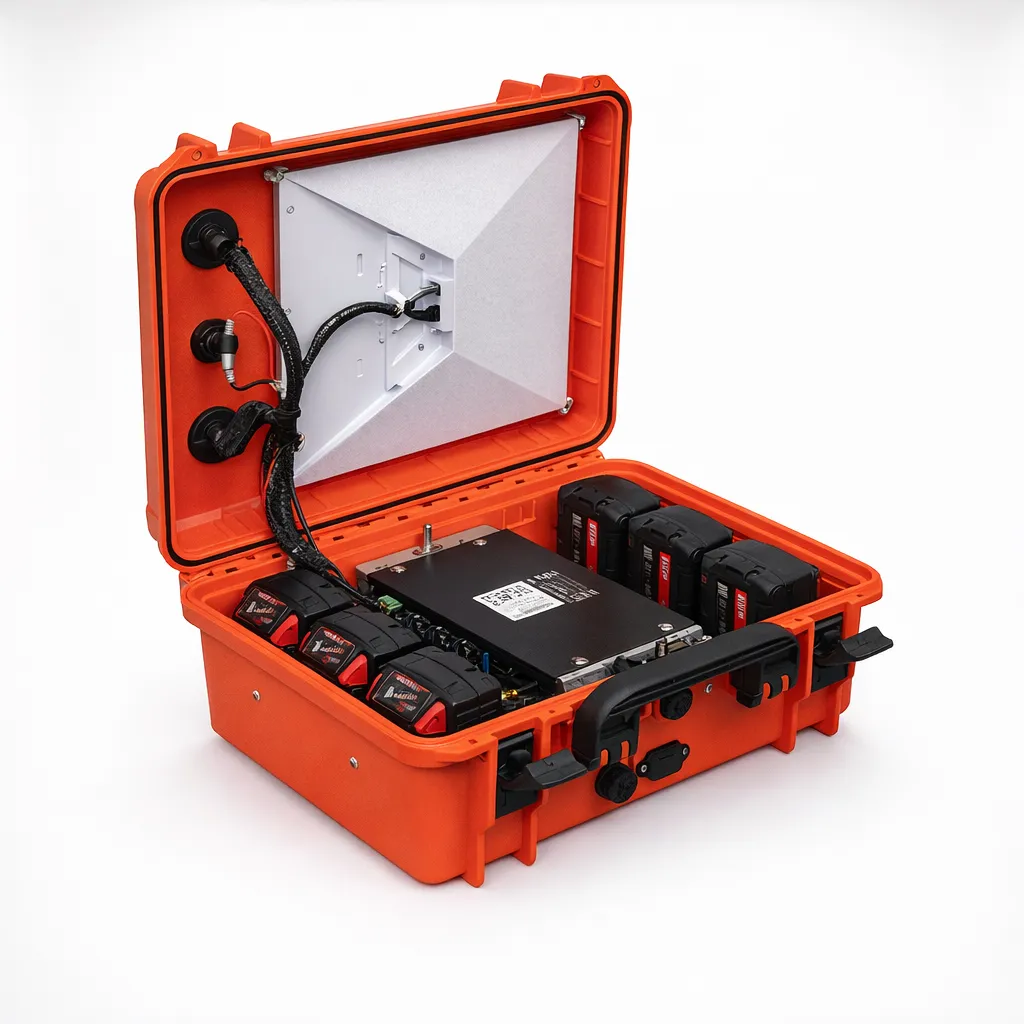
MIMO GO Case — portable connectivity that’s ready when you are
A self-sufficient, portable solution that blends satellite and cellular connectivity to keep operations connected across changing environments.
Highlights
Internet signal diversity for better resilience
Global coverage on land and ocean
Extended battery use and easy transport
User signal selection and remote monitoring/support
Easy to toggle power source and store securely

MIMO Curve — high-performance Starlink + 5G, built for serious environments
Powered by a Celerway Stratus 5G Router and a Starlink Performance 3 Panel, the MIMO Curve is engineered for fast deployment, high throughput and resilient multi-WAN connectivity in a marine-grade, durable housing.
Key capabilities
Supports multiple simultaneous WAN connections with intelligent routing and failover
Enterprise-grade VPN options and encrypted connectivity
High-performance antennae supporting 3G/4G/5G, GPS and Wi-Fi
Durable marine-grade materials, tested for harsh conditions
Fast installation (Cat6/7 + power) with remote management and support tooling
Related Solutions
VSAT (Very Small Aperture Terminal) delivers reliable two-way satellite connectivity using compact ground stations — enabling secure voice, data and video communications in remote or underserved locations, without terrestrial dependencies.

Remote Connectivity

Natural Resource

Commercial Marine

Superyachts
Frequently Asked Questions
- What performance should we expect at sea or in remote regions?
Satellite links connect your site or vessel to the internet or a private network using space-based infrastructure. They are ideal when fixed lines are not present, cannot be installed in time, or lack resilience for mission critical work.
Use cases: offshore vessels, remote plants, mobile command posts, construction compounds, events and disaster recovery.
Why choose it: global reach, predictable deployment timelines and independence from local infrastructure.
Hybrid approach: many clients use satellite as the primary path in remote areas or as a back-up to terrestrial links in higher risk locations.
Comms-Spec compares options during design and will recommend a hybrid model if it provides better performance or resilience.
- What hardware is required and how is it installed?
Performance depends on the satellite orbit, service plan and terminal.
Latency: Low Earth Orbit typically provides lower latency suitable for voice, video meetings and remote control. Medium and Geostationary orbits have higher latency and suit bulk data, email, file transfer and streaming.
Throughput: sized to the busiest hour with headroom for CCTV bursts and software updates. We validate with real client mixes during acceptance tests.
Contention and fair use: shared networks may slow during peak periods. Plans can include committed rates, priority tiers or pooled allowances to control this.
Weather: heavy rain can affect some frequency bands. We mitigate with appropriate antennas, link budgets and adaptive coding.
Site conditions: clear sky view and correct mounting are essential. Obstructions, vibration and cable losses reduce performance.
Comms-Spec sets realistic targets in the design and documents expected latency, throughput and availability before deployment.
- How does weather affect service?
The terminal type matches the operational environment.
Land terminals: fixed or transportable antennas, modems, power supplies and surge protection. Clear line of sight to the sky is required and mounts are secured against wind load.
Maritime terminals: stabilised antennas to maintain lock while underway, marinised cabling and weather-rated enclosures. Placement considers mast shadowing, radar interference and maintenance access.
Indoor equipment: enterprise router or SD-WAN gateway, managed switch and power conditioning with UPS.
Safety and compliance: earthing, lightning protection, RF exposure spacing and documented safe working procedures.
Comms-Spec handles survey, mounting design, cabling, commissioning and handover with drawings and acceptance records.
- How does weather affect service?
The terminal type matches the operational environment.
Land terminals: fixed or transportable antennas, modems, power supplies and surge protection. Clear line of sight to the sky is required and mounts are secured against wind load.
Maritime terminals: stabilised antennas to maintain lock while underway, marinised cabling and weather-rated enclosures. Placement considers mast shadowing, radar interference and maintenance access.
Indoor equipment: enterprise router or SD-WAN gateway, managed switch and power conditioning with UPS.
Safety and compliance: earthing, lightning protection, RF exposure spacing and documented safe working procedures.
Comms-Spec handles survey, mounting design, cabling, commissioning and handover with drawings and acceptance records.
- Can satellite back up terrestrial links?
Security and integration are core to the design.
Encryption: IPSec or SSL VPNs protect traffic end to end, with strong authentication for administrators.
Segmentation: separate operational systems, staff and guest networks using VLANs and firewalls with least privilege rules.
Addressing: many services use carrier-grade NAT. We provide static public IPs or VPN termination as needed for inbound services and remote access.
Quality of service: voice, radio over IP and control protocols receive priority over bulk updates or guest browsing.
Logging and compliance: configuration backups, audit logs and retention settings aligned to your governance.
Comms-Spec can integrate satellite links into your SD-WAN so policies remain consistent across all sites.
- How is usage managed and secured?
Clear expectations and ongoing care keep the service effective and predictable.
Plans: choice of pay-as-you-go, capped, pooled or committed-rate services depending on usage patterns.
Usage management: dashboards and alerts for data consumption, with policies that protect priority applications from guest or background traffic.
Upgrades and seasonal changes: bandwidth can be increased for peak periods or reduced during off-season to control spend.
Support: 24/7 monitoring, helpdesk, remote diagnostics and field engineering where required.
Lifecycle: firmware updates, periodic performance reviews and capacity planning as your operations evolve.
Comms-Spec provides a single point of contact for the service plan, hardware and support, with service level reporting that shows availability, incidents and improvements.