
In-Building Mobile Signal Boosting Systems
Signal boosting captures weak outdoor signal, amplifies it, and redistributes it indoors using strategically placed indoor antennas — creating reliable coverage throughout the building.
Why LTE Signal Boosting is essential in modern buildings
When people can’t get signal indoors, it affects more than convenience — it impacts safety, service and operations.
Reliable guest experience
Fewer complaints, better reviews, less pressure on reception and support teams.
Stronger staff productivity
Dependable comms for on-the-move teams inside large buildings.
Support for critical systems
Keep connected devices and safety communications working consistently.
Coverage in hard areas
Lifts, stairwells, basements and thick-walled zones that kill mobile signal.
Reduced operational risk
Maintain contact during incidents, evacuations and emergency response.
Future-ready connectivity
Improve indoor 4G now with a path that supports 5G where required.
Enhancements that strengthen performance and safety
These elements make indoor boosting more reliable, more measurable, and better suited to demanding environments.
Indoor signal boosting designed around real risks
Comms-Spec delivers in-building mobile coverage as an engineered service — not a “plug-in gadget” — so performance is reliable and compliant.
Full coverage
We design coverage around your building layout to eliminate dead zones across rooms, corridors and operational spaces.
Guest experience
We prioritise the areas that generate complaints first — bedrooms, conference spaces and public zones — so Wi-Fi isn’t forced to carry the entire load.
Safety systems
We ensure coverage supports critical connectivity needs, including devices and emergency systems that can’t afford signal loss.
Lift autodiallers
We design coverage for lift environments where emergency autodiallers often struggle to reach the network inside concrete shafts.
Hospitals & critical sites
We support demanding environments where indoor coverage affects staff coordination and operational safety.
Trusted partner
We typically deploy these solutions through Sure Signal Solution, using proven systems designed for reliable in-building performance.
Indoor coverage you can trust
Signal boosting delivers value when it’s designed properly: survey → design → install → verify → support.
Dead zones indoors
Many buildings unintentionally block mobile signal. Modern materials, glazing and dense structures prevent outdoor 4G/5G from penetrating indoors, leaving staff and guests with dropped calls, slow data and unreliable connectivity.
An in-building signal booster captures the best available outdoor signal, amplifies it, and redistributes it indoors through an antenna network. This creates consistent coverage across the building rather than isolated “hot spots.”
How Comms-Spec adds value: We design coverage as a system — surveying the site, planning antenna placement and commissioning performance so the signal is reliable across real-use areas, not just near a single antenna.
Complaints in minutes
In hotels and public venues, poor signal becomes visible immediately. Guests complain within minutes, staff waste time troubleshooting, and service quality takes a hit — even when everything else is running smoothly.
A properly designed boosting system stabilises indoor connectivity, reducing dropouts and improving usable 4G/5G data throughout guest and staff zones. It helps prevent “service incidents” that are actually connectivity failures.
How Comms-Spec adds value: We prioritise coverage where it impacts experience most, then support the system so performance remains stable — because even short outages can be reputation-damaging.
Safety-critical connectivity
In certain environments, weak indoor signal becomes a safety issue. If staff can’t communicate reliably, or vital devices can’t connect when needed, small incidents can escalate quickly.
Indoor boosting ensures consistent 4G/5G signal for critical areas and connected systems — supporting dependable communication and device connectivity even in challenging building structures.
How Comms-Spec adds value: We design signal boosting with safety in mind — targeting critical zones, validating coverage, and ensuring the system supports reliable connectivity where the consequences of failure are highest.
Lift shaft failures
Lift cars and shafts are often signal black holes. Concrete, metal and enclosure prevent mobile signal reaching the lift, which is a major issue when lift autodiallers rely on 4G to connect to a call centre during emergencies.
Targeted indoor coverage design can improve connectivity in lift environments by extending usable signal into the areas that standard coverage cannot reach.
How Comms-Spec adds value: We treat lift connectivity as a specific design requirement — planning coverage intentionally for enclosed shafts and validating performance so emergency systems can connect when they’re needed most.

Built for hotels, hospitals and large buildings
Indoor mobile coverage is increasingly essential — not optional. Whether it’s guest experience, staff coordination or critical device connectivity, LTE/5G signal boosting helps ensure your building stays connected where modern operations depend on it.
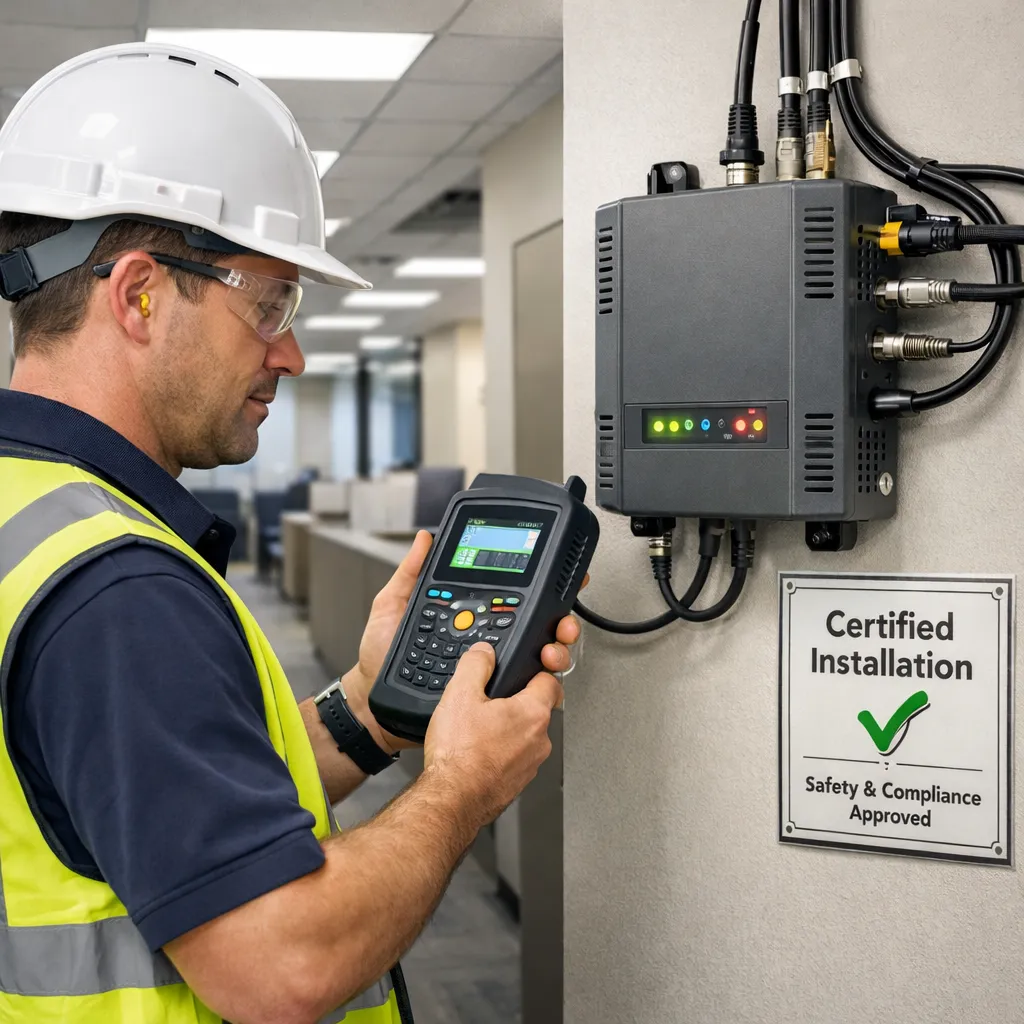
A compliant, professionally installed solution
Mobile signal boosting needs to be done properly to be safe, stable and effective. Comms-Spec typically delivers these systems through Sure Signal Solution — with design, installation and support focused on reliable indoor coverage that holds up under real usage.
Related Solutions
Signal boosting captures weak outdoor signal, amplifies it, and redistributes it indoors using strategically placed indoor antennas — creating reliable coverage throughout the building.

Close Protection
Remote Connectivity

Events
Frequently Asked Questions
- Is LTE boosting legal and compliant?
Yes, when the equipment and configuration meet local regulatory requirements.
We specify repeater systems that comply with national regulators and network operator rules, including limits on uplink noise, gain, and out-of-band emissions.
Where consent or specific device types are required, Comms-Spec handles approvals and documents serial numbers, locations, and settings for audit.
Systems are configured to shut down automatically if they detect oscillation or parameters outside the allowed range.
In multi-country estates we align each site to the local framework and brief stakeholders on responsibilities.
Regulations vary by country, so we build compliance into the design and commissioning process from day one.
- How much improvement can we expect?
Results depend on the quality of the outdoor signal and the materials inside the building.
Typical outcomes include moving indoor RSRP and SINR into healthy ranges, stabilising VoLTE calls, and significantly improving upload and download speeds.
Boosters cannot create signal where none exists. If there is no usable outdoor signal, we propose alternatives such as small cells, private LTE or satellite connectivity.
Throughput is still bounded by the serving network’s capacity. A booster improves radio conditions but cannot exceed what the network can deliver.
We validate performance with before and after walk tests, call quality checks, and throughput sampling in agreed zones.
- Can one system support multiple networks?
Yes. We design for the bands and operators you need.
Multi-band systems can cover common LTE bands and can be specified to include 5G where permitted and practical.
Where 5G mid-band coverage is required, we assess whether a booster, a small cell, or a hybrid approach is the right fit for your site.
We consider voice paths too. With many regions retiring 3G, VoLTE readiness is checked to keep voice stable while data runs on LTE or 5G.
Designs are modular, so additional operators or bands can be added later with minimal disruption.
- Can one system support multiple networks?
A site-specific design is essential for consistent results.
Survey: we measure outdoor signal levels and quality, run spectrum sweeps, and review floor plans and construction materials.
Donor antenna placement: we select a high, clear location with strong serving-cell signal and achieve sufficient isolation from indoor antennas.
Distribution: we build an indoor DAS using splitters, taps, and coax or fibre to feed ceiling antennas. For corridors, ships, or tunnels we use leaky feeder where suitable.
Modelling and zoning: heat maps and antenna layouts target coverage by floor and priority areas, avoiding overspill between zones.
Commissioning: we balance downlink and uplink gain, confirm isolation margins, and complete walk tests and acceptance reports.
- What is required for installation?
Protection of the wider network and user safety are central to the design.
Automatic gain control and oscillation detection keep the system stable and prevent uplink noise from leaking into the macro network.
Band-selective filtering avoids amplifying unwanted channels.
Antenna isolation is confirmed during commissioning and documented in the handover pack.
RF exposure remains within recognised guidelines by using low-power indoor antennas with appropriate placement.
Continuous health monitoring raises alerts for oscillation, high noise floor, VSWR faults, and power issues so we can act before service degrades.
- Will it help in large or multi storey buildings?
Ongoing assurance keeps performance consistent and audit ready.
Monitoring: remote dashboards for alarms, gain levels, temperature, and donor signal quality.
Planned maintenance: periodic checks on connectors, cables, antennas, and firmware, with documented results.
Power resilience: UPS for key components and graceful shutdown settings to protect equipment.
Runbooks: clear procedures for staff, including fault reporting, escalation, and safe isolation.
Alternatives: where coverage or capacity needs exceed what a booster can deliver, we design small cells, private LTE or 5G networks, or combine LTE boosting with Wi-Fi calling and satellite backhaul for full resilience.
Comms-Spec provides full design packs, regulatory documentation, commissioning records, and service level support so your enhanced coverage remains reliable throughout its life cycle.