
Intruder Alarm System Types
The right alarm system depends on the environment, the level of risk and the practical realities of installation. We design systems that balance reliability, flexibility and future scalability.
Why Intruder Alarms are essential in modern security
A professionally designed intruder alarm system doesn’t just “go off” — it deters, detects, verifies and drives a coordinated response that protects people, assets and continuity.
Deterrence
Visible sirens, strobes and signage discourage attempts before they start.
Rapid detection & response
Real-time triggers enable immediate verification and dispatch.
Asset & inventory protection
Reduce theft risk for valuable items, equipment and sensitive areas.
Operational continuity
Prevent incidents escalating into downtime and disruption.
Lower insurance exposure
Compliant, professionally installed systems can support improved terms.
Compliance support
Helps meet security expectations in regulated and high-risk environments.
Detection technologies that strengthen coverage
These sensors and detection layers improve accuracy, reduce blind spots and create earlier warning — especially across large or high-risk environments.
Intruder alarms designed as a response system
Comms-Spec designs intruder alarms around how incidents actually unfold — detection, verification, escalation and response — then integrates the technology so operators act with clarity, not guesswork.
Perimeter first
We build early-warning layers so threats are detected at the boundary, giving teams time to verify and respond before escalation.
Fewer false alarms
We combine detection with verification workflows and analytics so teams aren’t overwhelmed by nuisance triggers.
Verified escalation
We connect alarms to monitoring workflows so incidents are verified quickly and escalated in a structured way.
Single dashboard
We integrate alarms with CCTV, access control and comms for one operational view and simpler day-to-day management.
Remote oversight
We enable secure remote viewing and alerting so stakeholders can monitor and respond without being onsite.
Resilience built in
We design power backup and comms redundancy so alarms still function during outages, interference or disruption.
Intruder detection that holds up under pressure
The best alarm systems don’t just trigger — they help teams make faster decisions with fewer mistakes.
False alarm fatigue
When alerts trigger constantly, teams stop trusting them. Over time, nuisance alarms cause slower responses, wasted call-outs and missed genuine incidents because operators become desensitised.
Video verification and intelligent analytics help confirm whether an alarm is real. By linking sensors to CCTV and using classification logic, you reduce noise and focus attention on genuine threats.
How Comms-Spec adds value: We tune detection zones, thresholds and verification workflows to your environment, so alerts remain credible and actionable — improving response speed without increasing workload.
Perimeter blind spots
If detection starts inside the building, you’ve already lost time. Intruders exploit dark corners, long fence lines and remote approach routes where standard coverage is weakest.
Perimeter intrusion detection creates earlier warning using fence-mounted sensors, buried detection, beams, seismic sensing and other boundary technologies — allowing intervention before access is gained.
How Comms-Spec adds value: We design perimeter detection as a layered system, choosing the right sensor types for terrain and conditions, then commissioning coverage so “dead zones” don’t become repeat entry points.
Disconnected security tools
When alarms, CCTV, access control and comms sit on separate systems, response slows down. Operators waste time switching screens and piecing together what happened, where, and who is responding.
Integrated systems allow a single trigger to drive coordinated actions: cue cameras, send alerts, lock doors, and activate deterrence — all from one operating picture.
How Comms-Spec adds value: We build joined-up workflows that connect detection to verification and response, ensuring the system behaves like one coordinated capability rather than a collection of separate products.
Power and comms failure
Intrusions often happen when conditions are favourable to the attacker — during outages, disruption, or when connectivity is unreliable. If alarm systems fail under those conditions, the security layer collapses.
Resilient designs use battery backup, secondary comms paths and managed connectivity so the alarm can still trigger, transmit and escalate even when normal infrastructure is compromised.
How Comms-Spec adds value: We specify resilience intentionally — power backup, comms redundancy and stable signal paths — then test and commission the system so performance holds up when conditions degrade.
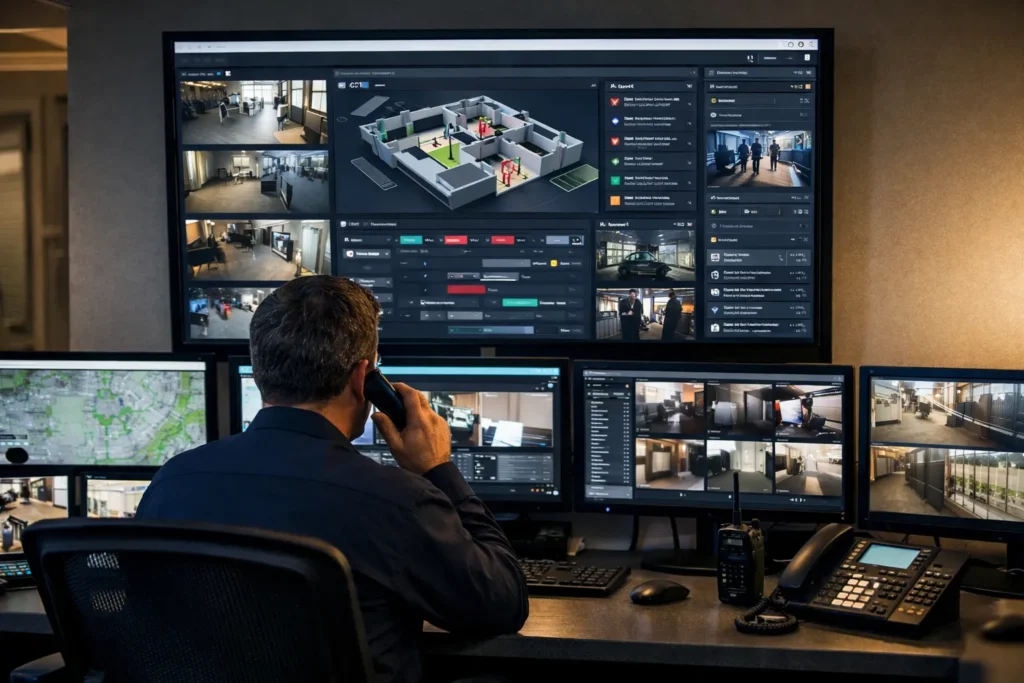
Integration turns alarms into action
An intruder alarm is most powerful when it triggers a joined-up response. When detection, CCTV verification, access control actions and Hybrid Radio alerts work together, teams get faster clarity and better control — reducing risk and improving outcomes.
What integrated alarms can enable
- Cameras automatically focus on the triggered zone
- Doors or gates lock down designated areas
- Alerts reach the right teams immediately via radio and mobile
- Lights and deterrents activate to discourage intrusion
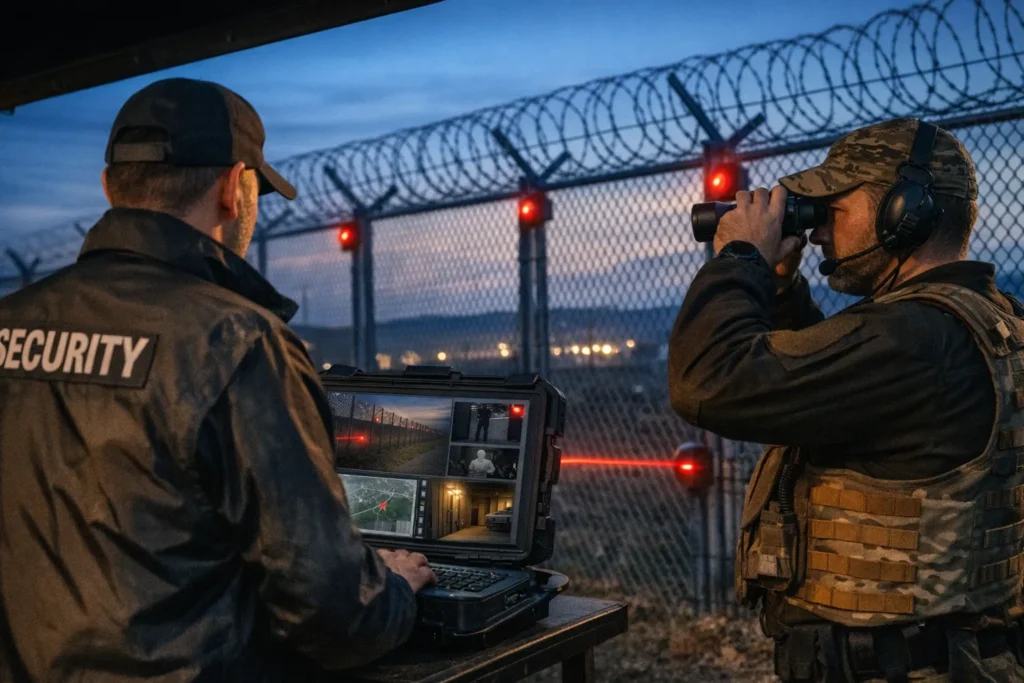
Intruder alarms for high-risk environments
From Grade 2/3 systems for businesses to high-security designs for critical sites and large-scale perimeter protection, Comms-Spec delivers intruder alarm solutions that match risk, environment and operational consequences — engineered to reduce false alarms, speed up verification, and support a reliable response model.
Related Solutions
The right alarm system depends on the environment, the level of risk and the practical realities of installation. We design systems that balance reliability, flexibility and future scalability.

Hotels and Luxury Properties

Ports

Stadiums
Frequently Asked Questions
- What sensors are used and where are they placed?
Selecting the right sensor for each location is the foundation of a reliable system.
Perimeter contacts for doors, shutters and windows, using magnetic reed contacts or heavy duty roller contacts.
Motion detectors including PIR for standard rooms, dual-technology PIR plus microwave for harsh or drafty areas, long-range sensors for corridors.
Glass break and acoustic sensors for glazed frontages and showrooms.
Vibration and shock sensors for safes, walls, fences and cages where forced entry is a risk.
Active beams such as infrared or microwave along external perimeters or loading bays.
Outdoor detectors with pet immunity and anti-masking features where wildlife or vehicles are present.
Comms-Spec performs a risk and environment survey, then positions sensors to cover likely attack paths, entry points and approach routes, while avoiding heat sources, moving foliage, or reflective surfaces that can cause false trips.
- How are alarms verified to reduce false call outs?
Design and configuration minimise nuisance while preserving sensitivity.
Cross-zoning and dual knock so two related sensors must confirm within a short window.
Video verification that pairs alarms with nearby cameras and auto-bookmarks footage for the operator.
Entry and exit routes with timed delays on designated doors only, so users can arm and disarm safely.
Environmental tuning such as sensitivity profiles for day and night, pet immunity, and masking detection to spot tampering.
Analytics and rules that suppress repeat triggers from the same sensor within seconds unless corroborated elsewhere.
Commissioning tests that prove each sensor’s field of view and catch performance, documented for handover.
These measures keep the system responsive to real intrusion while reducing unnecessary call-outs.
- Who receives alerts and how quickly?
Alert handling follows a clear escalation plan that suits your site and hours of operation.
Primary routing to your control room or an Alarm Receiving Centre with sensor, time, area and location data.
Keyholder and on-call notifications to radios, smartphones or pagers, with acknowledgement controls.
Video or audio verification where configured, to assess the event and reduce unnecessary dispatch.
Police or guarding response in line with your response policy and local requirements.
Incident logging with timestamps, operator notes and actions taken, ready for investigation or insurance reporting.
Comms-Spec designs the routing table, sets call trees for working hours and out of hours, and tests the full path during commissioning.
- Who receives alerts and how quickly?
esilience is built in from sensor to signalling.
Battery back-up for panels, expanders and sounders, with health monitoring and replacement schedules.
Dual-path signalling using IP plus cellular, with supervised polling so a path failure raises a trouble alarm.
Edge buffering so events are stored locally and forwarded when connectivity returns.
Local sounders and strobes that still activate on confirmed intrusion if the uplink is unavailable.
Documented fallbacks such as manual call procedures and emergency arming profiles during partial outages.
Design choices are recorded in your runbook so everyone knows what to expect in each failure scenario.
- Will the system still work if power or the network fails?
Yes. Integration improves speed and consistency of response.
CCTV integration to call camera presets, display live views, and attach clips to the incident record.
Access control linkage to lock, unlock or isolate zones, and to create muster or lockdown states.
Lighting and PA to deter intruders, guide evacuation, or support first responders.
Service and ticketing to raise maintenance jobs automatically when device faults are detected.
Digital twin and dashboards to visualise alarms on a live map with nearby assets and recent events.
Comms-Spec sets event rules so a single alarm can trigger the right combination of alerts and actions without operator delay.
- How often should the system be tested?
Planned assurance keeps performance high and records audit ready.
Routine user tests for arming, disarming and panic inputs, with monthly or weekly test schedules.
Engineer maintenance for sensor cleaning, alignment checks, tamper testing and firmware updates, typically once or twice per year depending on risk.
Health monitoring for battery life, link supervision, device heartbeat and fault codes, with automated notifications.
Change control that revisits sensor aiming and rules when layouts or uses change.
Documentation including zone lists, site plans, response procedures, training records and retention policies for logs.
Standards alignment with relevant British and European requirements appropriate to your risk grade and insurance conditions.
Comms-Spec provides handover packs, operator training and service level reporting, and remains available with remote diagnostics and on-site support whenever required.