
Two-way radio devices
We supply and configure handhelds, base stations, vehicle radios, and push-to-talk over cellular—so each role gets the right device for the environment and operational needs.
What you gain with the right system
Designed properly, two-way radio becomes an operational advantage—clearer, faster, and more reliable than ad-hoc comms.
Faster coordination
Instant voice to the right people—no dialling, no delays.
Better operational control
Structured talkgroups, call priorities, and clear escalation.
Coverage certainty
Designed performance where phones struggle—indoors and outdoors.
Safety options
Emergency alerts, lone worker, and man-down (where supported).
Secure communications
Encryption and access control options to suit your risk profile.
Scales with you
Add users, sites, and capacity without replacing everything.
Accessories that make radios easier to use
The right audio setup can transform usability—making comms discreet, clearer in noise, and faster to operate in the real world.
Choose the right two-way radio setup
Most teams don’t need “a radio”—they need a system that fits the environment, the workflow, and the risk. Use the guide below to find the simplest setup that meets your coverage and safety needs.
Single-site coverage
Handheld radios configured for talkgroups and roles. Add a repeater and antenna if the site is large or signal needs to reach across buildings and outdoor areas.
Fix dead spots (buildings/vessels)
Indoor distribution is often the answer. We design repeaters and Distributed Antenna Systems (DAS) to deliver signal where teams actually work—basements, plant rooms, corridors, cabins, and service areas.
Vehicles + mobile teams
Mobile radios installed in vehicles for always-on comms on the move, paired with handhelds for teams on foot. Ideal for estates, ports, logistics, and response operations.
Multi-site / wide-area coverage
Link repeaters over IP for estate-wide or multi-location coverage. We design networks that stay consistent across sites and support growth without constant rebuilds.
Discreet comms
Handhelds with covert audio and simple push-to-talk accessories. Perfect for hospitality, security, and guest-facing environments where comms must be subtle and professional.
Hazardous environments (ATEX)
ATEX/intrinsically safe handheld radios designed for explosive or volatile environments. We’ll specify the right devices and accessories for the area classification and workflow.
High traffic / peak demand
Capacity-focused digital networks designed for many users and talkgroups—reducing busy channels and missed calls during peak periods and incidents.
Coverage engineering and system expansion
Coverage is rarely solved by “stronger radios.” It’s solved by designing the network—repeaters, antenna placement, indoor distribution, and (when needed) multi-site linking and capacity management.
Repeaters
When teams can’t hear each other across a site, it’s rarely a “radio problem”—it’s a coverage design problem. Buildings, terrain, distance, and structural materials all reduce direct radio-to-radio range, creating dead zones and broken comms at the worst moments.
A repeater solves this by acting as a central relay point, extending usable coverage and making communications consistent across a wider area. We specify the right repeater type, power, and location, then programme your radios with the right channels/talkgroups so teams don’t waste time troubleshooting in the field.
How Comms-Spec adds value: We design repeaters as part of a complete system—surveying the site, selecting the correct antenna solution, and commissioning the setup so it delivers real talk-in/talk-out performance, not just “it works outside.”
Mast Antennas
Many radio issues come down to one thing: the antenna isn’t where it needs to be. Even high-quality radios struggle if the antenna is poorly placed, blocked by buildings, or too low to serve a wide area. The result is patchy comms, intermittent audio, and teams constantly moving to “find signal.”
A mast-mounted antenna increases height, line-of-sight, and overall coverage stability. It’s one of the most effective ways to improve performance across large outdoor footprints—especially estates, campuses, ports, and remote sites.
How Comms-Spec adds value: We don’t “just stick an antenna up.” We plan antenna type, height, location, cable runs, grounding, and system tuning—so the improvement is measurable and reliable. The goal is a system your teams trust without thinking about it.
Distributed Antenna Systems (DAS)
If radios work outside but fail in key indoor areas—basements, plant rooms, stairwells, corridors, service routes—it’s usually because the building is absorbing or blocking signal. This is especially common in multi-storey properties, steel-heavy structures, and vessels, where you need coverage everywhere, not just near windows.
A Distributed Antenna System (DAS) solves this by carrying radio signal throughout the building or vessel via a network of antennas placed where teams actually operate. Instead of hoping handheld radios “punch through,” DAS makes comms predictable across critical spaces—supporting faster response, safer lone working, and better coordination.
How Comms-Spec adds value: We design DAS around your operational map—not just floorplans. That means identifying priority areas (security routes, comms hotspots, incident locations), commissioning the system, and validating coverage so you’re not guessing during a real event.
IP Site Connect (Motorola IP Site Connect)
Motorola IP Site Connect allows multiple radio repeaters to be connected over an IP network, creating a wide-area communication system that functions as one unified network.
Using Motorola’s IP Site Connect technology, teams across large facilities, multiple buildings, or geographically separated sites can communicate as if they were operating on the same local radio system. This is ideal for organisations managing multiple sites that require seamless, reliable communication.
How Comms-Spec adds value: We design the network architecture and resilience around your reality—site connectivity, failover expectations, and who needs to talk to whom. Then we configure the radios, talkgroups, and user permissions so the system is simple to use and hard to misuse.
Capacity Plus & Capacity Max
Motorola Capacity Plus and Capacity Max systems enable large numbers of users to operate on the same radio network without congestion.
Using intelligent channel management, Capacity Plus and Capacity Max automatically allocate available capacity where it is needed most. This ensures reliable communication even in busy environments such as large hotels, major events, industrial sites, or multi-team security operations where many users need simultaneous access to radio channels.
How Comms-Spec adds value: We match capacity design to your operation—estimating traffic demand, structuring talkgroups, setting call priorities, and commissioning performance. The outcome is a network engineered for your busiest day, not your quietest one.
Trunked Options (e.g., TETRA)
Some operations need more than conventional radio: they need structured access, high traffic handling, and consistent, managed communications—especially where comms are part of critical response and operational governance.
Trunked radio solutions (such as TETRA in applicable scenarios) are designed to allocate resources dynamically and support large user bases with strong control over groups, permissions, and network behaviour. For the right use case, trunking brings a more “managed network” approach to radio communications.
How Comms-Spec adds value: We’ll only recommend trunking when it genuinely fits the need. Our role is to translate your operational requirement into the right architecture—whether that’s trunked, conventional digital, or a hybrid approach—then deliver deployment, configuration, and support that keeps performance dependable over time.
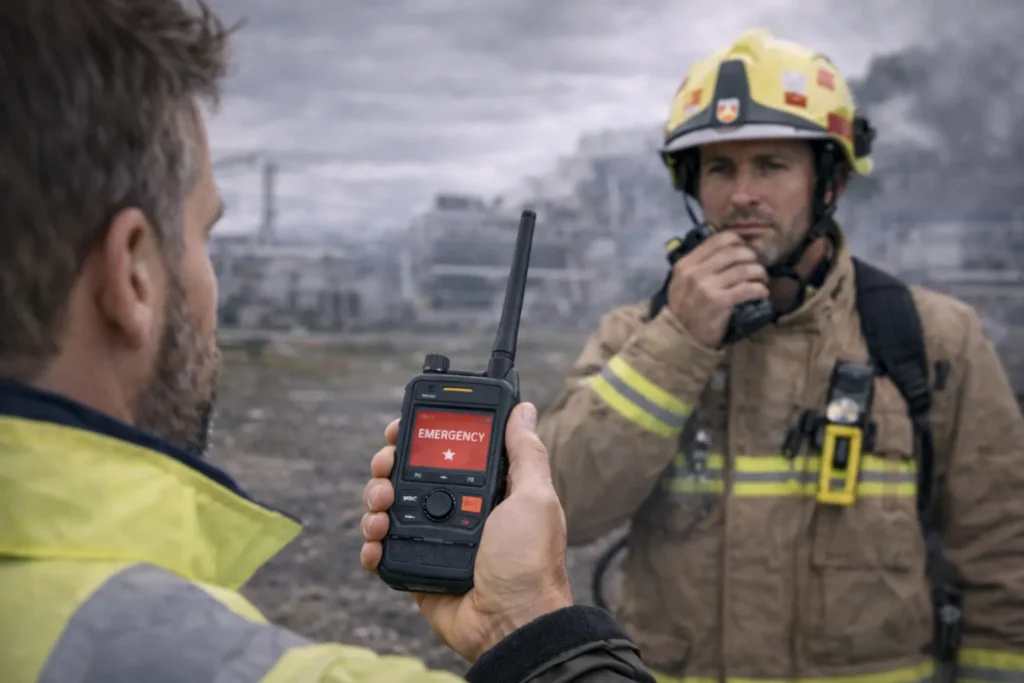
Built for safety-critical and security-sensitive work
When comms are part of your safety system, you need more than clear audio. We specify devices and configurations that support escalation, accountability, and controlled access.
Emergency alerts and priority calling (where supported)
Lone worker and man-down options (where supported)
GPS location and fleet visibility (where supported)
Encryption and controlled access (system/model dependent)
Role-based programming: who can talk to who, and when
Clear incident workflows: groups, supervisors, escalation
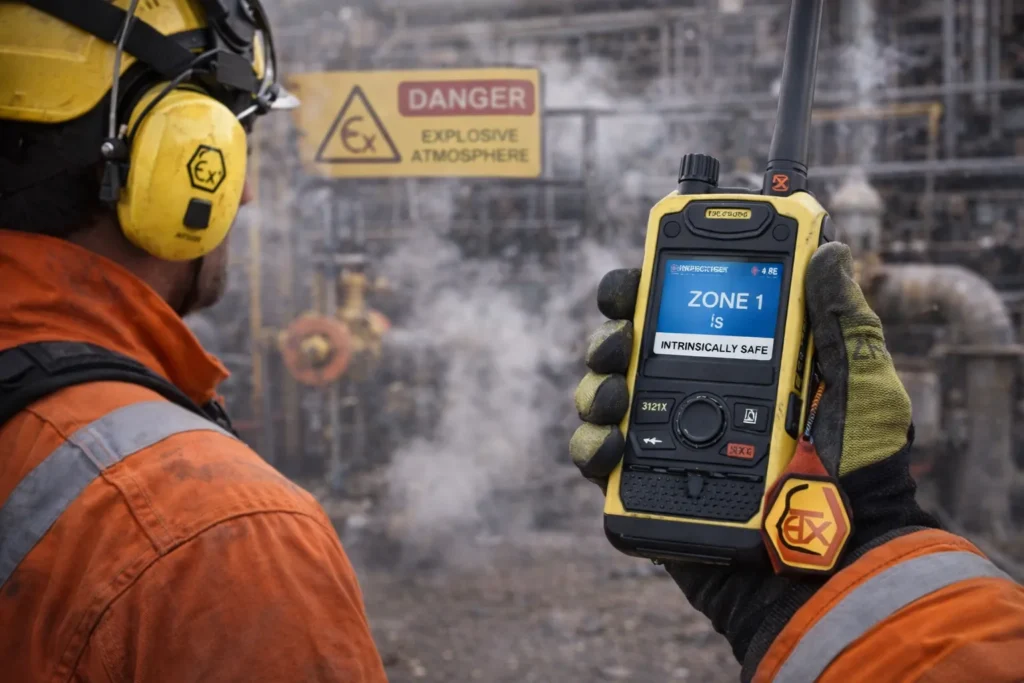
ATEX / Intrinsically Safe radios
For explosive or volatile environments, we supply ATEX-rated handheld radios and accessories to support safe, reliable communication in hazardous areas. We’ll match the kit to the role, zone requirements, and working conditions.
Related Solutions
We supply and configure handhelds, base stations, vehicle radios, and push-to-talk over cellular—so each role gets the right device for the environment and operational needs.

Close Protection

Commercial Marine

Hotels and Luxury Properties

Events

Natural Resource

Ports

Stadiums

Superyachts
Frequently Asked Questions
- What’s the difference between a two-way radio solution compared to walkie talkies?
A “solution” is the complete communication system, not just the handhelds. For many sites, radios that work perfectly in one area can fail in another due to building materials, basements, long corridors, steel structures, or distance. A proper two-way radio solution includes the right device types (handheld, mobile, base), the right coverage design (repeaters, antennas, indoor distribution), and the right configuration (talkgroups, priorities, safety features, encryption where needed).
How Comms-Spec helps: we design the system around how your teams actually operate, then deploy, programme, test, and support it so it works reliably day-to-day.
- How far do two-way radios work?
Range depends far more on the environment than on the radio itself. Open areas can give strong performance, but buildings, terrain, and steel/concrete can dramatically reduce coverage. “Stated range” figures you see online rarely reflect real-world site conditions.
What to do instead: define where you need coverage (floors, basements, yards, routes) and design for it.
How Comms-Spec helps: we recommend the simplest setup that meets your coverage requirement—often handhelds alone for small sites, or handhelds plus repeater/antenna/DAS for more complex environments.
- Do we need a repeater, and what does it do?
If your team has dead spots, inconsistent audio, or can’t communicate across a larger footprint, you likely need a repeater. A repeater acts as a relay point, extending coverage and making comms consistent across wider areas. It’s one of the most effective ways to transform “radios that sometimes work” into a dependable system.
How Comms-Spec helps: we design repeater placement, antenna strategy, and programming so performance is predictable—then commission and validate it to ensure it works where you need it.
- How do you get radio coverage inside buildings (hotels, basements, multi-storey sites)?
Indoor coverage problems are usually caused by the structure absorbing or blocking signal. In these cases, the fix isn’t “stronger radios”—it’s the right infrastructure. Common solutions include repeaters with properly placed antennas, or a Distributed Antenna System (DAS) to bring signal into the areas that matter.
How Comms-Spec helps: we design indoor coverage around operational spaces (plant rooms, corridors, loading areas, stairwells, guest/service routes), then commission and test so coverage is usable under real working conditions.
- What’s the difference between analogue, digital (DMR), and TETRA?
Analogue: simple, cost-effective, and familiar—often ideal for smaller teams with basic voice needs.
Digital (DMR): typically adds clearer audio at the edge of coverage, improved efficiency, and advanced features such as better group management and optional safety/security functions depending on model and configuration.
TETRA: a trunked, mission-critical style approach used in specific high-demand environments where structured access, high traffic handling, and network behaviour are key requirements.
How Comms-Spec helps: we recommend the simplest technology that meets your operational need, rather than over-specifying.
- Are two-way radios secure, and can they be encrypted?
Yes. Modern digital radio systems support advanced encryption, preventing unauthorised users from listening to communications.
Many professional systems support AES (Advanced Encryption Standard) — often referred to as military-grade encryption — which provides a very high level of communication security.
This is particularly important for security teams, close protection, event control, and critical operations, where sensitive information must remain confidential.
How Comms-Spec helps: we assess your risk profile (who needs to hear what, where sensitive info is shared, what “good” looks like), then specify and configure the right security approach for your operation.
- What is Push-to-Talk over Cellular (PoC), and when is it better than radio?
PoC gives you a “radio-style” push-to-talk experience using 4G/Wi-Fi coverage rather than local radio coverage. It can be ideal for multi-site teams, nationwide operations, remote staff, or hybrid workforces where traditional radio coverage isn’t practical.
Traditional radio is often better for site-specific operations where you want dedicated local coverage independent of public networks.
How Comms-Spec helps: we’ll recommend radio, PoC, or a hybrid based on footprint, reliability expectations, and day-to-day workflows.
- Do two-way radios require a licence in the UK?
Often, yes, depending on the equipment and how/where it’s used. Some licence-free options exist for specific use cases, but many professional deployments use licensed frequencies for better control and performance.
How Comms-Spec helps: we advise on the correct route and handle the practical steps so your system is compliant and optimised for your environment.
- How quickly can you deploy a two-way radio system?
Deployment time depends on complexity. Small deployments (handhelds + programming) can be quick. Coverage-engineered solutions (repeaters, antennas, DAS, multi-site linking) require design and commissioning to ensure performance is reliable.
How Comms-Spec helps: we scope quickly, recommend the simplest viable setup, and deliver a staged plan—so you can get immediate capability now and scale properly when needed.