
VoIP Phone Systems (Cloud PBX + Unified Comms)
A VoIP system replaces traditional landlines with internet-based calling and a unified communications platform — improving flexibility, professionalism and efficiency.
Why VoIP is the modern standard for business communications
VoIP doesn’t just replace a phone line — it modernises how teams communicate, serve customers, and work remotely.
Lower infrastructure burden
No separate phone wiring; use existing network and connectivity.
More flexible working
Staff can call and manage comms from mobile apps or browser logins.
Better customer experience
Smarter routing, handling, and faster team collaboration.
Stronger internal coordination
Instant messaging and file sharing reduce friction and delays.
Scales easily
Add users, extensions and features without major hardware change.
Centralised control
Manage the system, users and features in one place.
Extras that make VoIP more powerful
These components and features enhance usability, reliability and service quality — especially for customer-facing teams and busy environments.
VoIP built around your operation
Comms-Spec delivers VoIP as a complete solution — selecting the right platform and hardware, deploying it over your existing connectivity, and supporting it day-to-day.
Remote working
We enable app and browser-based calling so teams can work from anywhere using Wi-Fi and 4G/5G — without being tied to desks or office handsets.
Front desk control
We configure switchboard workflows, call routing and transfers so customer calls are handled faster and more professionally.
Unified comms
We consolidate calling, messaging, file sharing, video and meetings under one system to reduce tool sprawl and improve collaboration.
Hotel operations
We deploy hospitality-ready VoIP setups with guest features and PMS integration to improve service and streamline reception workflows.
Easy deployment
We implement VoIP over your existing network and connectivity so installs are quicker and more cost-effective than legacy telephony.
Always-on support
We provide remote servicing and amendments 24/7/365 so issues can be resolved quickly and changes don’t wait for site visits.
A phone system that does more
VoIP delivers the most value when it’s designed as a unified workflow: handle calls well → stay mobile → collaborate faster → support continuously.
Desk-bound phone systems
Traditional telephony ties teams to fixed locations and limits how quickly you can respond, transfer calls, or work across sites. When people are mobile or remote, service quality suffers and internal coordination slows down.
VoIP removes the desk dependency by running calls through cloud apps and browser logins, while still supporting desk phones where needed. Teams can answer calls, transfer, message and collaborate from anywhere with Wi-Fi and 4G/5G.
How Comms-Spec adds value: We design the system around your real working patterns — choosing the right mix of hardware and softphones, setting up user groups and call flows, and ensuring mobility doesn’t reduce professionalism.
Too many comms tools
When calling, messaging, video and file sharing sit in separate platforms, teams waste time switching tools, duplicating contacts, and missing context. This adds friction, cost and avoidable delays.
A unified VoIP platform combines calling with messaging, file/media sharing, video calls and virtual meetings — turning your phone system into a broader communications hub.
How Comms-Spec adds value: We configure features so they’re actually used — setting up workflows, access and permissions that match roles, and reducing redundant systems rather than adding “more features nobody adopts.”
Hotel guest expectations
In hospitality, even short outages cause immediate complaints and damage guest experience. Legacy systems can also limit guest features and create admin-heavy reception workflows.
Hospitality-focused VoIP platforms add features like wake-up calls, DND, easy checkout and personalised greetings, while PMS integration supports guest name display and smoother billing and checkout processes.
How Comms-Spec adds value: We implement VoIP as part of the hotel operation — configuring the guest feature set, integrating with PMS where required, and providing responsive remote support to protect uptime and service quality.
Downtime and slow changes
When making changes requires site visits or specialist scheduling, small issues become big disruptions. In customer-facing environments, even minutes of phone downtime can be costly.
Cloud-based VoIP enables remote diagnostics, servicing and configuration changes — helping issues get resolved faster and updates happen without waiting for on-site intervention.
How Comms-Spec adds value: We provide skilled remote support and ongoing system management, keeping your setup current and stable while handling changes quickly as your business evolves.
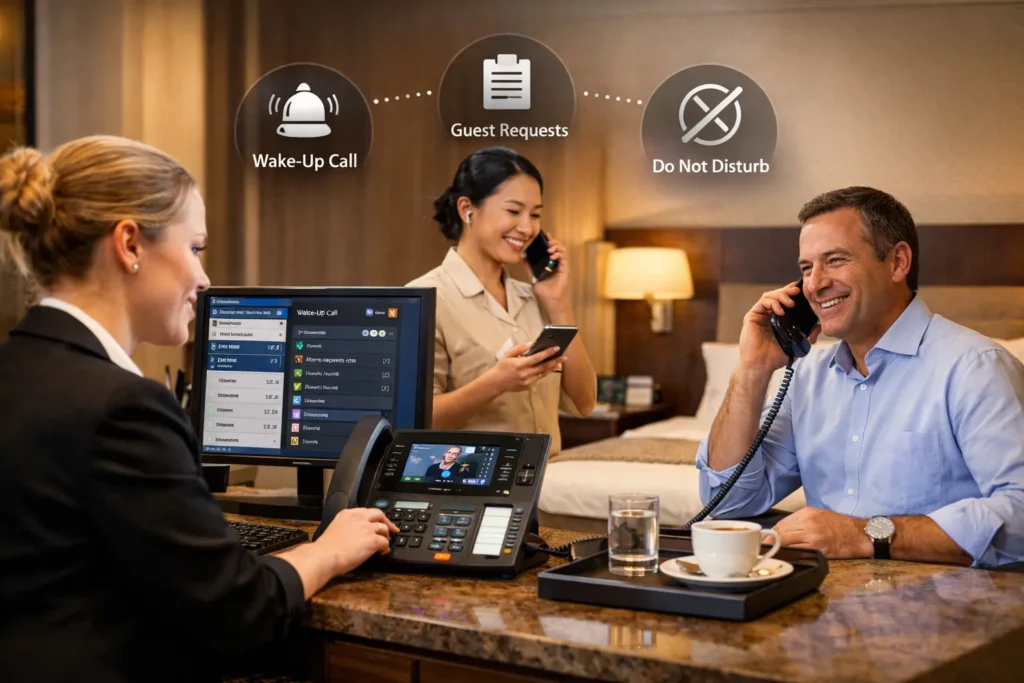
VoIP for hotels: built to improve service
VoIP is transforming hospitality because it supports both internal and guest communications from one system. With guest-focused features and PMS integration, it strengthens service delivery while streamlining reception operations.
Hospitality features can include
Wake-up call scheduling
DND and easy checkout workflows
Personalised greetings for front desk calls
Guest name display and smoother billing via PMS integration
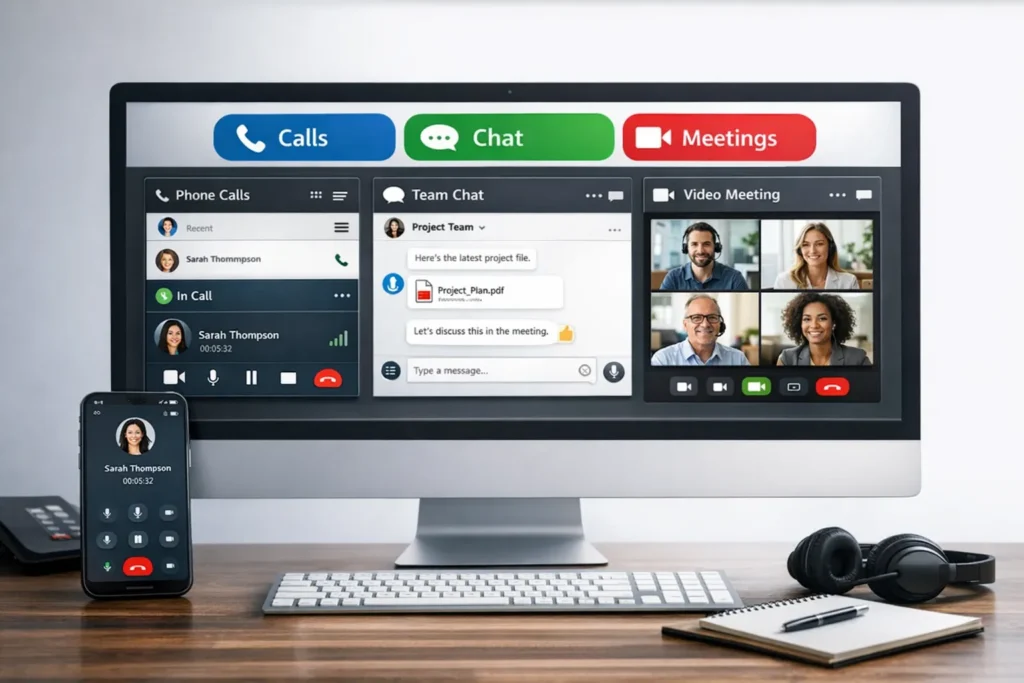
One system for calls, chat and meetings
A VoIP platform can replace multiple disconnected tools by combining calling with instant messaging, file/media sharing, video calling and virtual meetings. That means less spend on redundant systems — and a more connected, responsive team.
Related Solutions
A VoIP system replaces traditional landlines with internet-based calling and a unified communications platform — improving flexibility, professionalism and efficiency.

Hotels and Luxury Properties

Ports

Stadiums
Frequently Asked Questions
- How do you ensure call quality?
Quality is engineered rather than hoped for.
Network assessment to check bandwidth, latency, jitter and packet loss at busy times.
QoS and VLANs so voice traffic is prioritised, marked correctly and separated from heavy data flows.
Power and switching with PoE for desk phones, UPS on core switches and routers, and monitoring for congestion.
SBCs and media gateways to manage SIP signalling, NAT traversal and codec negotiation cleanly.
Codecs and echo control chosen for the site and links, with wideband audio where the network allows.
Acceptance testing for MOS scores, failover behaviour and call quality during peak load before go live.
- What happens if the internet link fails?
We design around your scale, locations and governance.
Cloud hosted PBX for quick rollout, easy scaling and minimal on-site equipment.
On-premises IP PBX where data residency, local control or custom integrations are important.
Hybrid with on-prem for core sites and cloud for remote branches or overflow.
SIP trunks sized for your busy hour and growth plans, with options for geographic numbers and international routing.
Decision factors include resilience needs, integration depth, call volumes, compliance, and the skills you want to retain in-house.
We provide a simple decision matrix and total cost view for each option.
- Can VoIP integrate with radios and paging?
Yes. Interoperability is a core part of the design.
Radio integration so desk phones and incident rooms can reach radio talkgroups through a gateway.
Paging and PA to trigger site-wide announcements or zone messages from handsets or softphones.
Door phones and intercoms with video and remote door release from selected extensions.
Contact centre features such as IVR, call queues, skills-based routing, wallboards and call recording with role-based access.
Security platforms where emergency calls raise incident cards, notify control rooms and bookmark relevant CCTV automatically.
- Can VoIP integrate with radios and paging?
Emergency handling is designed and tested.
Correct routing to local emergency services such as 999 and 112, with per-site trunks where needed.
Location information that includes building, floor and room where possible, updated when phones move.
On-site alerts so security or reception receives a screen pop or message when an emergency call is placed.
Power resilience using UPS for core voice components and PoE switches so phones remain live during short outages.
Fallback paths such as analogue lines, mobile gateways or satellite for sites with higher risk.
Regular drills to confirm routing, location data and on-site notifications behave as expected.
- Do you support emergency calling requirements?
Security and governance are built in.
Encryption with TLS for signalling and SRTP for media, plus strong ciphers and certificate management.
Access controls using role-based permissions, MFA for administrators and segregated management networks.
SBC policy to block toll fraud, rate-limit registrations and enforce geo or time rules for calling.
Patching and hardening for phones, PBX, SBC and gateways, with unused services disabled.
Recording and retention where policy allows, with watermarking, secure storage and audit trails for access and export.
Logging and monitoring for call anomalies, registration failures and quality alerts with clear runbooks.
- What features are available for operations and hospitality?
Migration is phased and low risk.
Discovery of numbers, call flows, hunt groups, fax or analogue devices and any special lines.
Number porting planned with parallel running where needed and clear rollback points.
Device strategy that may mix desk phones, cordless DECT, softphones and mobile apps.
User readiness with short training, cheat sheets and clear guidance for headsets and softphone use.
Go live support on-site or remote, followed by a bedding-in review to tune queues, IVR and reporting.
Ongoing service including monitoring, firmware updates, capacity reviews and helpdesk with defined response times.
Comms-Spec remains your single point of contact for trunks, platforms and endpoints so the service stays reliable and adapts as your organisation changes.