
Integrated Security System Components
A modern integrated security system brings multiple layers into one coordinated network — detection, verification, access control, command-and-control, and response.
Why integrated Security Systems outperform standalone tools
Security is strongest when it’s layered, connected, and designed to slow down intruders while accelerating your response.
Layered Defence That Buys Time
deter, detect, deny, delay and defend as one strategy.
Quicker verification
Link alarms to CCTV for immediate visual confirmation.
Smarter automation
Reduce manual monitoring and human error with rule-based actions.
Better operational efficiency
Fewer false alarms and clearer operator workflows.
Compliance support
Help meet requirements for critical sectors and regulated sites.
Lower long-term risk cost
Reduce downtime exposure and improve resilience planning.
Specialist tools for borders & critical infrastructure
Some environments need wider-area detection, longer range monitoring, and resilience engineered into every layer. These technologies expand capability across large perimeters and high-risk sites.
Integrated security that matches your operating model
Comms-Spec designs security systems around your risks, response capability and environment — then integrates the right components so operators can see, decide and act faster.
Hybrid threats
We build cyber-physical security thinking into system design, reducing the chance that one breach or compromise cascades across multiple systems.
Perimeter defence
We combine physical barriers with detection layers (sensors, radar, cameras) to identify threats early and slow down intrusion attempts.
Verified response
We integrate alarms with CCTV and command-and-control so operators can confirm events quickly and respond with confidence.
Automation rules
We configure smart triggers — so detection events can cue cameras, alert teams, activate deterrence or lock down sensitive zones automatically.
Border monitoring
For large-scale perimeters, we integrate long-range detection and unmanned tools to expand coverage and reduce blind spots.
Control room ops
We plan and scope control rooms and joint operations centres that support multi-agency coordination and real-time situational awareness.
More than security hardware — a working system
Integrated security succeeds when it’s engineered as a layered defence with clear operator workflows, reliable comms, and resilience across every link.
The 5D layered defence
Most security fails because it’s too thin. A single camera, a standalone alarm, or one access system can’t slow a determined threat — and it doesn’t give your team enough time to verify and respond.
Layered defence applies multiple stages: deter, detect, deny, delay and defend. By combining perimeter detection, verification, controlled access and response tools, you turn security into a time-buying strategy — not a single point of failure.
How Comms-Spec adds value: We design your layers to work together, not overlap randomly — aligning detection zones, camera coverage, access points and response actions so your team gains time, clarity and control during incidents.
Alarm-to-camera verification
Unverified alarms create hesitation. Too many false activations lead to slower responses, operator fatigue, and the risk of missing the one alert that matters.
Integrated systems can “slew-to-cue” cameras automatically when sensors detect movement, placing the right live view in front of operators immediately. This turns alerts into evidence and speeds up decision-making.
How Comms-Spec adds value: We design verification workflows that match your site and staffing — configuring triggers, camera behaviours and control room views so operators don’t hunt for information under pressure.
Resilience for critical sites
Critical infrastructure can’t rely on fragile links. Power disruption, network failure or a cyber compromise can disable isolated systems — and attackers can exploit those gaps to move deeper into a site.
Resilient security designs include redundancy and hardened links so failures don’t cascade. Systems remain operational, and the control layer continues to collect, display and act on events even under disruption.
How Comms-Spec adds value: We plan resilience into the full security architecture — considering power continuity, connectivity, segmentation and the handoffs between systems so your defence remains intact when conditions degrade.
Comms + video integration
Security response often breaks down at the handover — operators see something, but response teams don’t get the right information quickly enough to act safely and effectively.
Hybrid radio integration unifies voice, data and alerts with surveillance, enabling teams to share incident context (location, status, imagery and escalation) across formerly separate systems — especially valuable for remote or wide-area operations.
How Comms-Spec adds value: We connect communications into the security workflow — ensuring alerts, GPS, and incident updates reach the right teams fast, with a structure that supports coordinated response rather than fragmented reactions.
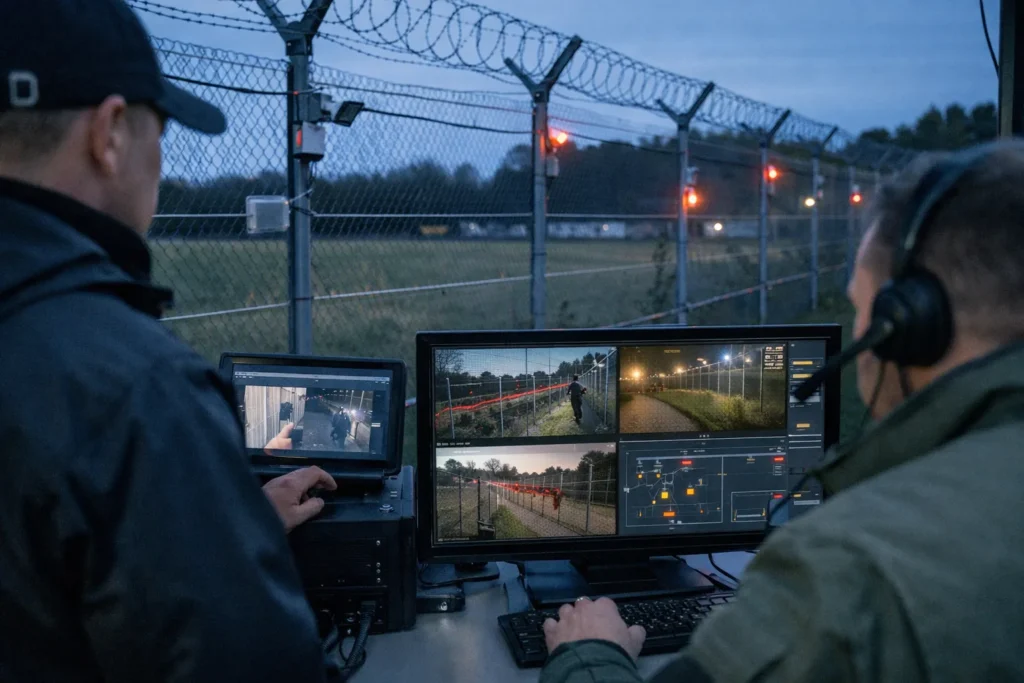
Border-grade capability for wide-area security
For borders and expansive perimeters, integrated security extends beyond fences and fixed cameras. Drones, radar, AI-enabled thermal surveillance and advanced sensing add long-range monitoring and rapid verification — improving coverage and reducing blind spots where threats can move unnoticed.
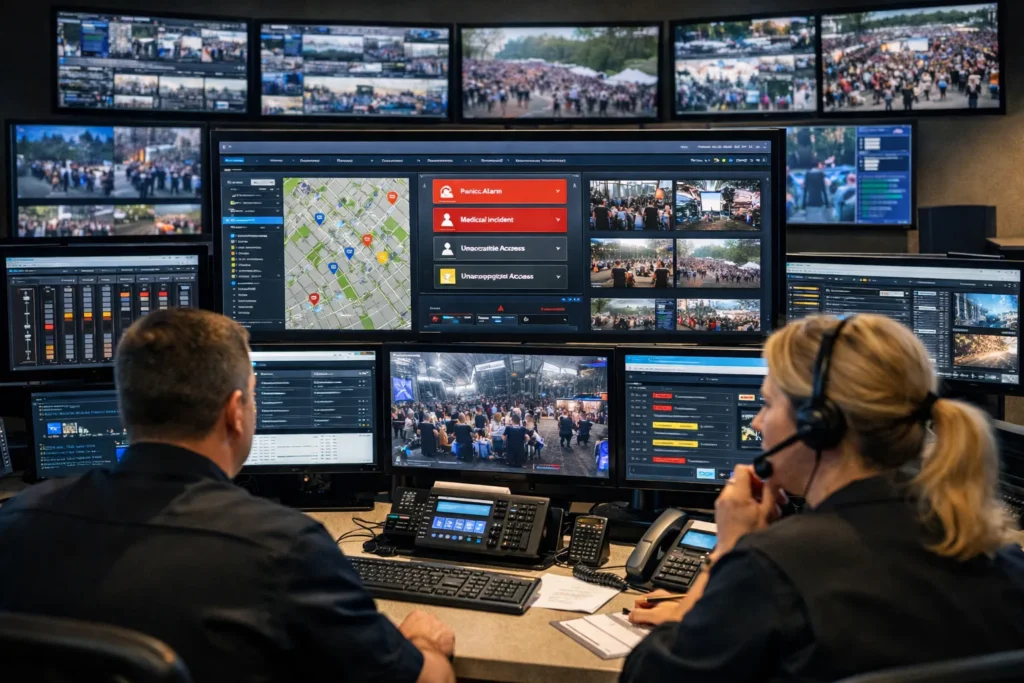
Control Room / Joint Operations Centre (JOC) design
When multiple teams, agencies or chains of command must coordinate, a control room or JOC becomes the operational backbone. Comms-Spec plans, designs and scopes JOCs to support complex operations with clarity and control.
What a JOC enables
- Integrated command support and secure communications
- Real-time situational awareness and live video feeds
- Coordinated multi-agency response on a common platform
- Incident mapping, logistics and resource management
- A central contact point for mission planning and control
Related Solutions
A modern integrated security system brings multiple layers into one coordinated network — detection, verification, access control, command-and-control, and response.

Close Protection

Commercial Marine

Events

Hotels and Luxury Properties

Natural Resource

Ports
Stadiums

Superyachts
Frequently Asked Questions
- What layers make up a modern security system?
Layering creates multiple opportunities to detect, delay and respond.
Perimeter: fencing and gates, beams, fence vibration sensors, radar or lidar where appropriate.
Site approaches and vehicles: ANPR, vehicle barriers, intercoms and safe stand-off design.
Video: fixed, PTZ, multisensor and thermal cameras with analytics for intrusion, loitering and line crossing.
Access control: readers, controllers, lift control and visitor systems with role based permissions.
Intruder and panic: door contacts, motion, glass break, staff panic and emergency call points.
Public address and alerts: speakers, strobes and message boards for deter, evacuate or invacuate actions.
Control and communications: dispatcher console, radios, VoIP, and incident logging.
Visualisation: a central platform or digital twin that shows events on a live map with quick actions.
This approach improves detection speed, verification quality and response coordination, which lowers incident impact and supports compliance.
- How do you reduce nuisance alarms and confirm real incidents?
Design begins with risk and ends with measurable outcomes.
Threat and risk review: assets, likely adversaries, operating hours and environmental constraints.
Zoning: public, supervised, restricted and high security zones with clear transitions and signage.
Detection objectives: define detect, observe, recognise and identify targets at key points, then select sensors and lenses to meet those targets.
Workflows: who is notified, what they see, and what steps they follow for each event type.
Human factors: lighting, sight lines, camera heights, operator ergonomics and radio discipline.
Acceptance criteria: coverage heat maps, alarm latency, verification times and false alarm targets agreed before installation.
We provide drawings, device schedules and a delivery plan that fits operational windows, followed by a pilot area to validate assumptions.
- Can the system grow with our site?
Reliability comes from careful placement, tuned analytics and multi-sensor confirmation.
Sensor pairing: cross-zoning and dual knock so two related sensors confirm within a short window.
Video verification: camera call-ups and automatic bookmarks alongside the alarm event.
Context rules: different sensitivity and schedules for day, night and maintenance periods.
Environmental tuning: pet immunity, anti-masking, and exclusion zones to avoid foliage, reflections or HVAC drafts.
Learning loop: post-installation reviews that adjust rules based on incident data and alarm statistics.
Operator tools: clear alarm cards with snapshots and nearby devices so staff decide quickly and consistently.
The goal is fewer nuisance trips and faster, more confident decisions.
- Can the system grow with our site?
Yes. Integration reduces handoffs and speeds response.
Single interface: alarms, cameras, doors and radios in one console, with role based views for operators and supervisors.
Automations: an intrusion near a gate can cue a PTZ preset, lock a turnstile, start recording bookmarks and send a task to mobile responders.
Incident playbooks: step by step guidance, contact lists and prewritten messages appropriate to each scenario.
Evidence handling: watermarked video export with hash verification, attached notes and photos, and a complete event timeline.
APIs and standards: ONVIF for video, SDKs for access control and alarm panels, webhooks for ticketing and reporting platforms.
Operators work from a common operating picture rather than juggling separate applications.
- What standards and best practices do you follow?
Protection covers both physical and digital layers.
Power and networks: UPS for critical devices, diverse links where available, edge buffering for cameras and panels so events are not lost during outages.
Fail-safe behaviour: documented door modes, local sounders and emergency talkgroups when central services are degraded.
Cybersecurity: unique credentials, multi factor authentication, encrypted traffic, segmented networks for cameras and controllers, and signed firmware with change control.
Privacy: purpose limitation, privacy masking where needed, role based access to video and logs, and retention policies aligned to governance and law.
Monitoring: health dashboards for device heartbeat, storage, temperature and link status, with alerts before service degrades.
Runbooks describe what happens in each fault scenario so teams know exactly how to operate safely.
- How do you maintain system performance over time?
Security is a lifecycle, not a one-off project.
Planned maintenance: camera cleaning and refocus, sensor testing, battery replacements, firmware updates and alignment checks.
Routine drills: monthly user tests for alarms and panic, and periodic full exercises for lockdown, evacuation or shelter.
Training: operator induction, supervisor administration, quick reference cards and refresher sessions for new features.
Performance reporting: KPIs such as time to acknowledge, time to verify and false alarm rate, plus heat maps of incidents and device fault trends.
Change management: review layouts, rules and camera aims after refurbishments or process changes.
Service levels and spares: defined response times, swap stock for critical devices and quarterly improvement reviews.
Comms-Spec provides documentation, service reporting and a clear support path so the system remains effective and aligned to your evolving risk.