
Service Call options
Choose the hardware format and operational model that best fits your environment. We’ll configure touch actions, routing, and status behaviour to align with your service standards.
What you gain with the right system
Designed properly, Service Call becomes an operational advantage—protecting privacy, improving response times, and ensuring every request is handled with confidence.
Unrivalled privacy
Guests request service discreetly, without speaking.
Faster response
Direct alerts reduce delays and miscommunication
Clear accountability
Visible request status and structured workflows.
Consistent standards
Predefined actions keep service predictable.
Flexible use
Portable or built-in placement across spaces.
Always-on reliability
Monitoring helps prevent issues before they impact service.
Add-ons that make Service Call even smarter
These options help tailor the experience to your service style—improving discretion, clarity, and operational consistency.
Choose the right Service Call setup
The best setup depends on the environment, the service style, and how you want requests routed. Use the options below to find the most suitable approach quickly.
Guest suites and cabins
Buttons configured for the most common requests—steward call, housekeeping, room service—using multi-touch actions so guests don’t need multiple devices.
Night-time / silent service
Night mode profiles with adjusted light intensity and sound behaviour, designed to keep the environment calm while still ensuring staff receive clear alerts.
Stewarding and housekeeping workflows
Structured requests mapped to teams and zones so calls go to the right people first, with clear status confirmation to reduce repeated check-ins.
Spa and wellness environments
Quiet, discreet service requests that protect the guest experience—ideal for spaces where phone calls and verbal requests break the ambience.
Pool deck / outdoor areas
Flexible placement and robust hardware options suited to high-traffic service zones, helping staff respond quickly without constant visual scanning.
Multi-zone residences and estates
A consistent system across multiple rooms and zones—ideal for concierge/butler teams managing a property with predictable service standards.
High-privacy VIP service
Discreet requests without conversation, combined with controlled routing so alerts reach the appropriate staff without broadcasting the request.
Discreet emergency escalation
Emergency mode triggers an urgent, discreet alert that enables rapid response while preserving calm for guests.
Capabilities that elevate service delivery
Service Call works best when it’s designed around real behaviour: what guests expect, how staff operate, and what “excellent service” means in your environment.
Multi-touch requests
In luxury environments, the fastest way to create friction is to make guests think. If a guest has to work out how to request different types of service—or choose between multiple devices—requests become inconsistent and staff end up clarifying rather than delivering. That can turn “seamless service” into awkward moments and avoidable delays.
Multi-touch actions solve this by allowing one elegant button to represent multiple request types. A short press can call stewarding, a long press can request housekeeping, and a double press can trigger a predefined alternative—without adding clutter to the space. The guest experience stays simple; the staff experience becomes precise.
How Comms-Spec adds value: We don’t leave this to guesswork. We work with your team to define the right service menu, map touch actions to real workflows, and configure requests so they route correctly and consistently—then train staff on the response standard so the system feels natural from day one.
Intuitive request status
One of the biggest weaknesses of service buttons is uncertainty. If guests don’t know whether a request was received, they’ll press again, call anyway, or ask in person—creating duplicate tasks, extra interruptions, and a service experience that feels less controlled. On the staff side, unclear status increases repeat visits and unnecessary radio or corridor chatter.
Status feedback solves this by making request acknowledgement obvious. The light ring provides simple, intuitive confirmation that the request has been sent and is being handled—reducing repeat presses and removing anxiety for guests.
How Comms-Spec adds value: We configure feedback to match your service style. That means tuning brightness for luxury spaces, defining what “acknowledged” looks like, and ensuring staff processes align—so the system feels premium and reassuring, not flashy or disruptive.
Wi-Fi deployment with minimal infrastructure
Luxury interiors don’t tolerate invasive works. Traditional cabling-heavy systems can cause disruption, extend installation timelines, and add cost—especially on finished spaces where access routes are limited. The result is often compromise: fewer call points, rushed placement, or a system that doesn’t truly match how the environment is used.
A Wi-Fi-based service call system reduces complexity and speeds deployment. It allows elegant placement, fast commissioning, and easier change management—ideal for refits, upgrades, or environments where downtime needs to be minimal.
How Comms-Spec adds value: We treat deployment as an engineered solution, not “plug-and-play.” We assess connectivity, plan placement for reliable performance, configure the system for stability, and validate behaviour in real conditions—so you get the speed of Wi-Fi with the reliability expected in a premium environment.
Elegant materials and custom finishes
In seven-star environments, technology should never look like technology. Anything that feels cheap, generic, or out of place quietly erodes the guest experience. Even if the system works perfectly, a poorly matched device can feel like an afterthought—and that’s not acceptable in superyachts or luxury residences.
Premium materials and custom finishes solve this by allowing the service call button to complement the interior rather than compete with it. The hardware becomes part of the design language—subtle, intentional, and consistent with the space.
How Comms-Spec adds value: We help you select the right finish strategy and placement approach so the solution feels bespoke. It’s not just a device choice—it’s an experience choice, and we ensure the technology supports the standard you’re delivering.
Personalised guest experience
A service system that feels perfect during the day can become intrusive at night. Bright feedback lighting, audible confirmations, or “always the same behaviour” can disrupt sleep, spoil ambience, or break the calm that defines premium environments. Guests shouldn’t feel like they’re operating a device—they should feel like service is simply “there.”
Personalised settings solve this by adapting the system to time-of-day and space. Night mode can reduce light intensity and adjust behaviour so requests stay discreet, while still ensuring staff get clear, actionable alerts.
How Comms-Spec adds value: We design profiles for different areas (cabins, lounges, spa rooms) and different times (day/night), then test them with your team. The result is a solution that feels considered and consistent with the atmosphere you’ve created.
Portable or built-in deployment choices
Some spaces need flexibility. Others demand permanence. If everything is fixed, you lose adaptability for changing layouts, guest preferences, or seasonal operations. If everything is portable, consistency can suffer and devices can end up misplaced or underused.
Offering both portable and built-in options solves this by giving you the right approach for each zone. Fixed call points suit high-use, always-on spaces. Portable buttons suit adaptable spaces or situations where guests want service access in different locations.
How Comms-Spec adds value: We design the placement plan around real workflows—where requests happen, where staff respond from, and what “service availability” should feel like in each area. That ensures the system is used properly, not ignored.
Two-way operational control through app management
Service systems often fail quietly. Devices go offline, batteries run low, or configuration drifts—and the first time anyone notices is when a guest presses a button and nothing happens. In premium environments, that’s not just inconvenient; it damages trust instantly.
App-based management solves this by giving staff and managers oversight. You can confirm readiness, check device status, and maintain consistency across zones—reducing surprises and improving confidence in day-to-day operation.
How Comms-Spec adds value: We set up the management layer as part of the system design, not as an afterthought. We help define who monitors what, how often checks happen, and what the response process is—so reliability becomes proactive and embedded.
Smart monitoring for reliability
Luxury service has no tolerance for “sometimes.” If a system is only reliable most of the time, the rare failure is exactly what guests remember. Monitoring is how you protect the experience: it turns potential failures into manageable maintenance tasks.
Smart monitoring solves this by making readiness visible—battery levels, connectivity, and device health can be tracked so issues are detected early and resolved before they affect guests.
How Comms-Spec adds value: We configure monitoring and provide operational routines that keep the system dependable long-term. We also support ongoing optimisation so as your environment changes, your reliability doesn’t degrade.
Emergency mode for discreet escalation
In high-end environments, urgent situations need a faster path—but they still need to be handled discreetly. A loud commotion, obvious alarm, or chaotic response can create panic and disrupt the wider guest experience even if the incident is contained.
Emergency mode solves this by triggering a higher-priority alert that reaches the right people immediately, without broadcasting the situation publicly. It enables rapid response while preserving calm and privacy.
How Comms-Spec adds value: We design escalation paths with you—who receives urgent alerts, how they’re acknowledged, and how the response is coordinated—so the system supports swift action without compromising discretion.
Integration via API or Crestron
A standalone service call system can work—but it risks creating a “second workflow” staff have to manage. When alerts live in one place, room status in another, and guest experience controls elsewhere, tasks can be duplicated or missed, and service becomes less consistent.
Integration solves this by connecting Service Call into your wider operational or smart environment. Requests can be routed, logged, or paired with existing control ecosystems so staff stay in one workflow and the guest experience feels unified.
How Comms-Spec adds value: We scope integrations carefully, implement them cleanly, and support them after launch. The goal is a seamless, dependable workflow that improves service rather than adding complexity.
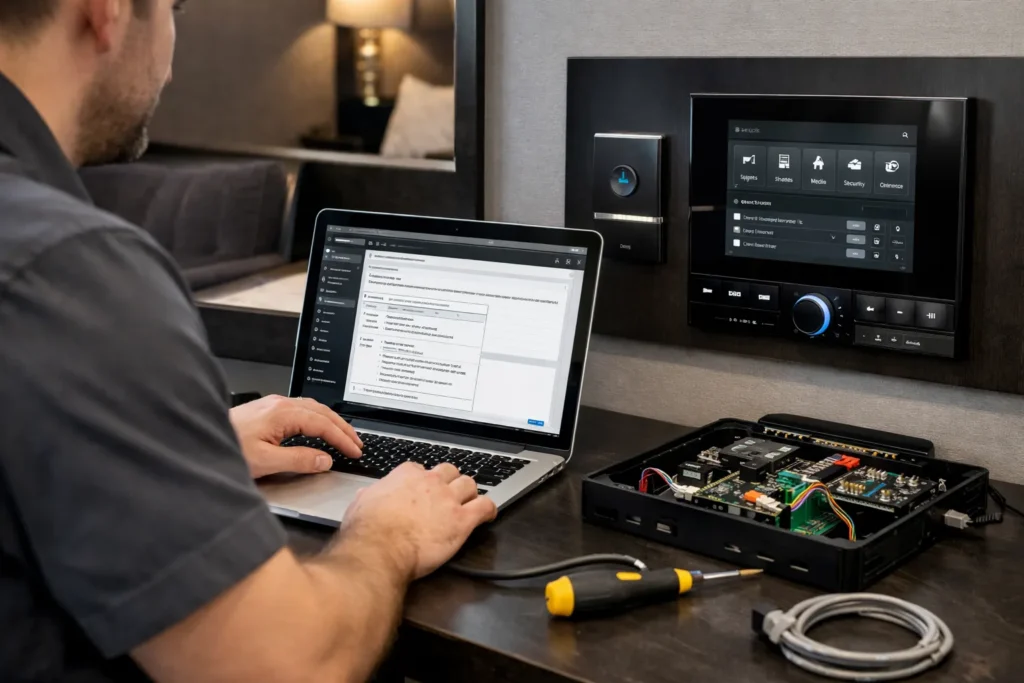
Privacy, discretion, and controlled service delivery
Premium service depends on two things: guests feeling undisturbed, and staff receiving the right information quickly—without broadcasting requests across the environment.
Discreet guest requests without calls or direct conversation
Clear acknowledgement reduces repeat presses and uncertainty
Controlled routing so the right staff respond first
Emergency escalation mode for urgent situations without disruption
Monitoring and oversight that supports always-on readiness
Engineered for demanding luxury environments
Service systems in superyachts and luxury properties must perform flawlessly—day after day, guest after guest. This solution is designed for durability, low-maintenance operation, and high reliability, with monitoring that supports 24/7 readiness and a premium finish that belongs in elite interiors.
Related Solutions
Choose the hardware format and operational model that best fits your environment. We’ll configure touch actions, routing, and status behaviour to align with your service standards.

Hotels and Luxury Properties

Superyachts

Events
Frequently Asked Questions
- What forms can a service call take?
Hardware and software options are chosen to suit the space and brand.
Wireless call buttons with single press or press and hold actions, LED feedback and optional vibration confirmation.
In-room tablets or touch panels with category menus such as housekeeping, maintenance and concierge.
QR codes or NFC tags that open a branded web form on the guest’s phone, useful where devices are shared or outdoors.
Mobile apps for venues with loyalty programmes or repeat visitors.
Smart TV or signage overlays for suites, boxes and long-stay rooms.
Voice assistants where appropriate, with privacy controls.
Typical locations include guest rooms and suites, meeting rooms, spa and pool areas, lounges, VIP boxes, parking lobbies and back-of-house desks.
- Where do requests appear and who receives them?
Rules make sure the right team receives the right request at the right time.
Routing by location and category to the nearest or most suitable team.
Skill based assignment so technical, housekeeping or concierge tickets go to trained staff.
Shift aware delivery that follows duty rosters and on-call schedules.
Multi-channel notifications to radios, smartphones and dispatcher consoles with clear tones and on-screen context.
Acknowledgement controls so a staff member accepts a task, which starts the response timer.
Escalation if not accepted or completed within the agreed time, with supervisor alerts and reassign options.
Guest confirmation by LED, on-screen message or SMS where enabled, so the requester knows help is on the way.
- Can we track response times and service quality?
Yes. Integration reduces double entry and improves visibility.
Property and room systems such as PMS, housekeeping status and room readiness.
Helpdesk and maintenance platforms for automatic ticket creation and closure with parts or labour notes.
Point of sale for chargeable requests and mini-bar replenishment.
Access control and lifts to grant temporary routes for staff responding to a request.
CCTV and analytics to bookmark relevant video where safeguarding is required.
Communications with two-way radios, push to talk applications and VoIP for voice follow up.
APIs and webhooks are used to push updates and receive status changes in real time.
- Can we track response times and service quality?
Design choices match the environment and expected load.
Enterprise Wi-Fi, sub-GHz mesh or PoE for call points, chosen after a survey.
Health monitoring for device heartbeats, battery level and signal quality, with automated fault tickets.
Local buffering so requests are stored if the link drops and delivered when it returns.
Redundant paths such as dual network links or cellular back-up for critical areas.
Power planning with long-life batteries, charging cradles and UPS where fixed devices are used.
User feedback on the device so guests do not repeat a request due to uncertainty.
- Can service calls link to our property or ticketing systems?
Privacy is built into the workflow.
Data minimisation. Only the information needed to fulfil the request is captured.
Role based access so staff see only the tasks and personal data relevant to their role.
Encryption in transit and at rest, with full audit logs of who viewed or changed records.
Configurable retention so task history and personal data are stored only for agreed periods.
Safeguarding options that route certain categories to trained responders and, if required, trigger discrete checks by supervisors.
Brand and signage guidance that sets clear expectations for guests on how requests are handled.
Comms-Spec provides configuration guidance and documentation to align with your policies and GDPR obligations.
- How do you ensure reliability?
Deployment is phased to deliver value quickly with minimal disruption.
Survey and design to confirm device mix, mounting and network coverage.
Pilot area to validate routing rules, notifications and staff workflows.
Branding and localisation with icons, languages and tone that fit your property or venue.
Training for front-of-house, housekeeping, maintenance and supervisors, with quick reference guides.
Go live support with on-site or remote engineers, then a review to tune categories and timers.
Ongoing service including monitoring, software updates, battery replacement schedules and quarterly reports on response metrics.