
Emergency & panic alarm options
Choose a solution that matches your environment, workforce, and response model. We’ll configure the workflows, location accuracy, escalation paths, and integrations so the system performs under pressure.
What you gain with the right system
Designed properly, emergency alerting becomes an operational advantage—faster response, clearer decisions, and better protection without disrupting the environment.
Faster response
Alerts reach the right people immediately.
Accurate location
Identify the incident location without guesswork.
Discreet activation
Calm, unobtrusive protection for staff and guests.
Stronger safety culture
Workers feel supported and protected.
Control-room clarity
Unified dashboards and structured escalation.
Audit and optimisation
Analytics that improve procedures over time.
Add-ons that strengthen emergency response
These options help tailor the system to your environment and improve performance, adoption, and control.
Choose the right emergency alert setup
The best solution depends on where the risk occurs, how accurately you need to locate it, and how you want incidents handled. Use the guide below to quickly find the most suitable approach.
Lone workers and staff on the move
A smartphone-based protection solution that turns existing mobiles into personal panic alarms—ideal for rapid rollout without new hardware.
Indoor accuracy
Indoor tracking with emergency alerts so you can pinpoint incidents inside buildings—supporting room-level visibility and rapid response.
Discreet front-of-house panic buttons
Small, hidden or adhesive panic buttons placed under desks, tables, or counters—quietly triggering alerts without escalating the situation.
Wearable panic alarms
Wrist straps and pocket buttons for roles that need instant access and hands-free practicality.
Security teams and patrols
Hybrid location that continues outside the premises, supporting teams moving between indoor and outdoor zones.
Man Down protection
Automatic alerts triggered by inactivity or tilt/fall detection—ideal for physical tasks carried out alone.
CCTV verification workflows
Alarm triggers can bring the relevant camera views to the front of the workflow—helping verify incidents quickly and guide response.
Multi-site standardisation
A repeatable solution across properties with consistent device configurations, escalation rules, and reporting.
Lockdown and mass notification
Zoned, priority messaging that can override normal content to deliver clear instructions during emergencies across targeted areas or entire sites.
Capabilities that turn alerts into outcomes
A panic alarm is only effective when it leads to fast, informed action. These capabilities reduce uncertainty, shorten response time, and create a protection system your teams can trust.
Smartphone panic alarm
When employees are on the move, the biggest risk is being alone with no fast way to raise the alarm—and no reliable way for responders to locate them quickly. Traditional devices can be costly to deploy at scale, and many organisations lose time waiting for procurement rather than protecting people now.
A smartphone-based panic alarm solves this by turning mobiles into a personal safety device. Staff can trigger an SOS quickly, and the system can provide immediate location and incident context—helping a control team make faster, better decisions in the moment.
How Comms-Spec adds value: We roll out the workforce quickly and configure the platform around your real-world risk scenarios, escalation rules, and response expectations—so the app becomes a working safety system, not just a download.
24/7 monitoring and response
Many alarm solutions fail at the hardest point: the moment an alert is triggered. If the response is unclear—who receives it, who acts, how quickly it’s verified—then staff lose confidence and alarms become “nice to have” rather than protection.
A dedicated monitoring and response capability solves this by ensuring there is always a trained team available to receive alerts, verify incidents, and coordinate escalation—day or night, weekends and holidays included.
How Comms-Spec adds value: We align monitoring workflows to your operation, define what “response” means for different alarm types, and ensure staff understand how the system behaves—so it supports duty of care consistently.
BS 8484 lone worker-aligned service delivery
Organisations increasingly need proof that lone worker protection isn’t improvised. Without recognised standards and clear operational processes, it’s harder to demonstrate duty of care, assess suppliers, or standardise across sites.
A BS 8484-aligned approach solves this by providing a recognised framework for lone worker device services and monitoring processes—helping ensure the system is built to respond reliably, not just to trigger alerts.
How Comms-Spec adds value: We help you implement protection as a programme—covering configuration, monitoring, staff training, and operational routines—so you can evidence a considered, professional approach to lone worker safety.
Indoor location + emergency alerts
Indoors, GPS is often unreliable or too vague. In real incidents, “somewhere in the building” isn’t enough—responders need to know which zone, floor, or room area to reach quickly, especially in large hotels, estates, hospitals, and complex sites.
Indoor tracking paired with emergency alerts solves this by providing accurate location inside the premises. When an alarm triggers, the control team can see exactly where it happened—reducing search time, improving coordination, and supporting faster intervention.
How Comms-Spec adds value: We design the indoor tracking to match your building layout and operational priorities, then validate performance so indoor location becomes actionable, not approximate.
Indoor tracking to GPS outdoors
Safety risks don’t stop at the door. Security staff, patrol teams, and lone workers move between indoor and outdoor areas—and continuity matters. If location tracking changes or drops as someone exits a building, responders lose time rebuilding context.
A hybrid approach solves this by supporting indoor location inside the premises and switching to outdoor GPS when the user leaves—maintaining continuity across the full incident journey.
How Comms-Spec adds value: We engineer the handover logic and define how alerts are handled across zones so the system remains consistent for both operators and responders.
Discreet panic buttons
Front-of-house incidents demand discretion. Staff often need to raise an alarm without escalating the situation, drawing attention, or moving away from a guest/customer at the wrong moment. Hard-wired solutions can be disruptive to install and visually intrusive.
Discreet adhesive panic buttons solve this by allowing hidden activation under desks, counters, or tables—no visible “panic station,” no complex install, and no attention drawn to the trigger point.
How Comms-Spec adds value: We plan placement based on real incident risk points and staff behaviour, then test activation and routing so alerts go to the right responders with the right context immediately.
Wearables and long-life devices
In high-risk roles, access speed matters. If staff need to find a phone, unlock it, or dig out a device, critical seconds are lost. Wearable and pocket-friendly devices reduce the friction between “I need help” and “help is on the way.”
Wearable panic devices solve this by keeping activation always available—wrist straps for instant access, pocket buttons for discreet carry, and long battery life for dependable operation.
How Comms-Spec adds value: We match form factor to role and environment, then implement simple usage standards so staff actually carry and use the device consistently.
Hub-based coverage and room-level visibility
Without a clean system architecture, button deployments can become messy—too many gateways, uncertain coverage, or unclear mapping from button to location. That increases setup time, complicates support, and weakens trust in the system.
A hub-based approach solves this by creating a centralised connection point that supports many buttons with defined coverage. It makes the deployment easier to manage and can deliver room-level visibility for responders.
How Comms-Spec adds value: We design the layout, coverage plan, and location mapping so the system is scalable, supportable, and consistent as you add devices or zones.
Control-room integration
When an alarm triggers, the fastest decisions come from verification: what’s happening, where it’s happening, and what responders are walking into. If operators must switch between separate systems, time is lost and critical details are missed.
Integrated workflows solve this by bringing alarms, maps, and relevant CCTV views into one operational flow—helping teams verify incidents quickly, coordinate staff, and manage exits/entrances in real time.
How Comms-Spec adds value: We scope integrations based on your existing systems, configure triggers and views intelligently, and test incident workflows so the integration improves response instead of adding complexity.
Lockdown & emergency mass notification
In large premises, the hardest challenge is communicating quickly, clearly, and consistently—especially when different areas need different instructions. Generic messaging causes confusion and delays; weak audio coverage leaves people uninformed; and lack of auditability creates risk.
A mass communication system solves this by delivering clear, audio-first instructions across your site or targeted zones, with priority overrides for emergency messaging. It supports pre-configured alerts and live announcements, and can be reinforced through screens and mobile devices.
How Comms-Spec adds value: We design zones and message priorities, help create effective content, configure the system for emergency override behaviour, and train your team—so you can deliver calm, precise instructions when it matters most.
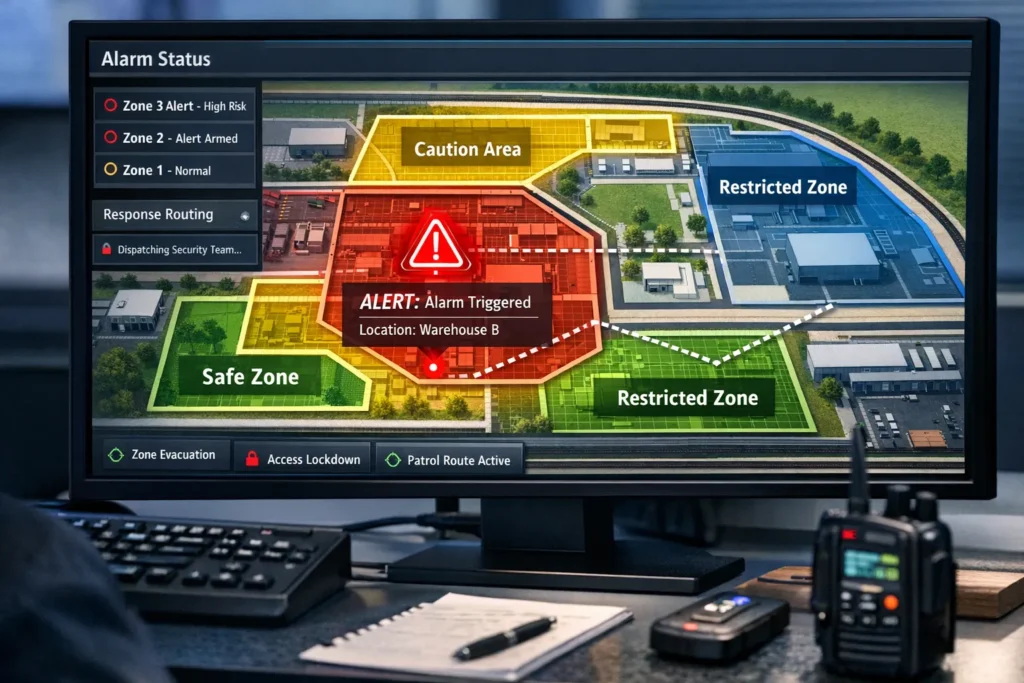
Discreet protection, controlled response
In safety-critical moments, you need discreet activation and clear operational control—so incidents are handled quickly without creating panic or disruption.
Discreet SOS activation for staff-facing risk scenarios
Clear location and identity associated to every alert
Escalation rules aligned to your SOPs
Control-room visibility to coordinate response teams effectively
Audit trails and reporting that support continuous improvement

Support duty of care and preparedness
Beyond incident response, organisations need confidence that their approach is structured, repeatable, and defensible. We help you standardise devices, procedures, escalation paths, and reporting across sites—so safety becomes a managed capability, not a collection of disconnected tools.
Related Solutions
Choose a solution that matches your environment, workforce, and response model. We’ll configure the workflows, location accuracy, escalation paths, and integrations so the system performs under pressure.

Events

Stadiums

Natural Resource

Ports

Hotels and Luxury Properties

Commercial Marine

Superyachts
Frequently Asked Questions
- What form factors are available for staff?
Panic alarms are dedicated or software-based tools that let staff raise an urgent request for assistance.
Wearables: badges, belt clips and wrist devices with a single press or squeeze action, vibration or LED feedback to confirm activation.
Fixed points: wall buttons, under-desk switches, foot pedals and pull cords for reception desks, offices or counters.
Smartphones and tablets: secure apps with on-screen panic, shake to alert and duress PIN options, useful for roaming staff.
Radio features: emergency buttons on professional radios, lone worker timers and man down tilt sensors.
Accessibility options: larger buttons, high contrast labels and audio prompts for inclusive use.
Comms-Spec recommends a mix of devices matched to work patterns so help can be requested from any typical location.
- How accurate is location during an incident?
Location is captured using the best available method for the environment.
Indoors: Bluetooth Low Energy beacons, Wi-Fi RTT and Ultra Wideband can provide room or zone accuracy.
Outdoors: GPS and GNSS provide coordinates that are mapped to the nearest access point or entrance.
Hybrid positioning: devices combine methods to improve accuracy and resilience, with floor level where supported.
Metadata: device ID, last known movement and recent check-ins help responders verify context.
During commissioning we validate location accuracy against agreed targets and document any known limitations.
- How are alerts escalated if not acknowledged?
Routing rules ensure the right people are notified quickly, with fallbacks for fault conditions.
Primary delivery: control room or dispatcher receives a priority alert with location, user identity and incident type.
Parallel notifications: radios, smartphones and desktop pop-ups receive the same alert with one-click navigation to the map or camera view.
Escalation: if the alert is not acknowledged within a set time it automatically escalates to supervisors or the next tier, with audible reminders.
Out of hours: rosters define who is on duty so alerts reach the right on-call team.
Resilience: dual-path signalling over IP and cellular, local sounders where required, and store and forward so events are queued if links drop.
Manual fallbacks: predefined radio talkgroups or phone trees are used if the platform is unavailable.
All acknowledgements and actions are time stamped to create a clear incident timeline.
- How are alerts escalated if not acknowledged?
Design balances speed with verification and clear feedback.
Two-stage actions where appropriate, such as press and hold, double press or a short cancel window.
Positive confirmation through haptic feedback, LEDs or a discreet tone so users know the alert was sent.
Supervised inputs that detect cable cuts, device removal and offline status and raise a fault rather than an alarm.
Role-based sensitivity so lone workers or high-risk roles use faster activation paths, while low-risk areas use confirm prompts.
Training and signage so staff understand when and how to use each device.
Test mode that allows drills without generating live incidents, while still logging the exercise for reports.
Where silent alarms are required we configure discreet confirmations and suppress local sounds or lights.
- Can the system integrate with radios and smartphones?
Yes. Integration improves speed and consistency of response.
CCTV: call nearby camera presets and bookmark footage for investigation.
Access control: unlock safe routes for responders or lock doors for containment based on pre-agreed rules.
Public address and messaging: trigger local announcements or silent notifications to designated teams.
Radio and telephony: open priority talkpaths or place automatic calls to responders.
Incident platforms and digital twin: create a structured incident with checklists and show the alert on a live map with nearby assets.
Comms-Spec builds playbooks so a single press results in coordinated actions while the operator supervises.
- How is privacy protected?
Yes. Integration improves speed and consistency of response.
CCTV: call nearby camera presets and bookmark footage for investigation.
Access control: unlock safe routes for responders or lock doors for containment based on pre-agreed rules.
Public address and messaging: trigger local announcements or silent notifications to designated teams.
Radio and telephony: open priority talkpaths or place automatic calls to responders.
Incident platforms and digital twin: create a structured incident with checklists and show the alert on a live map with nearby assets.
Comms-Spec builds playbooks so a single press results in coordinated actions while the operator supervises.